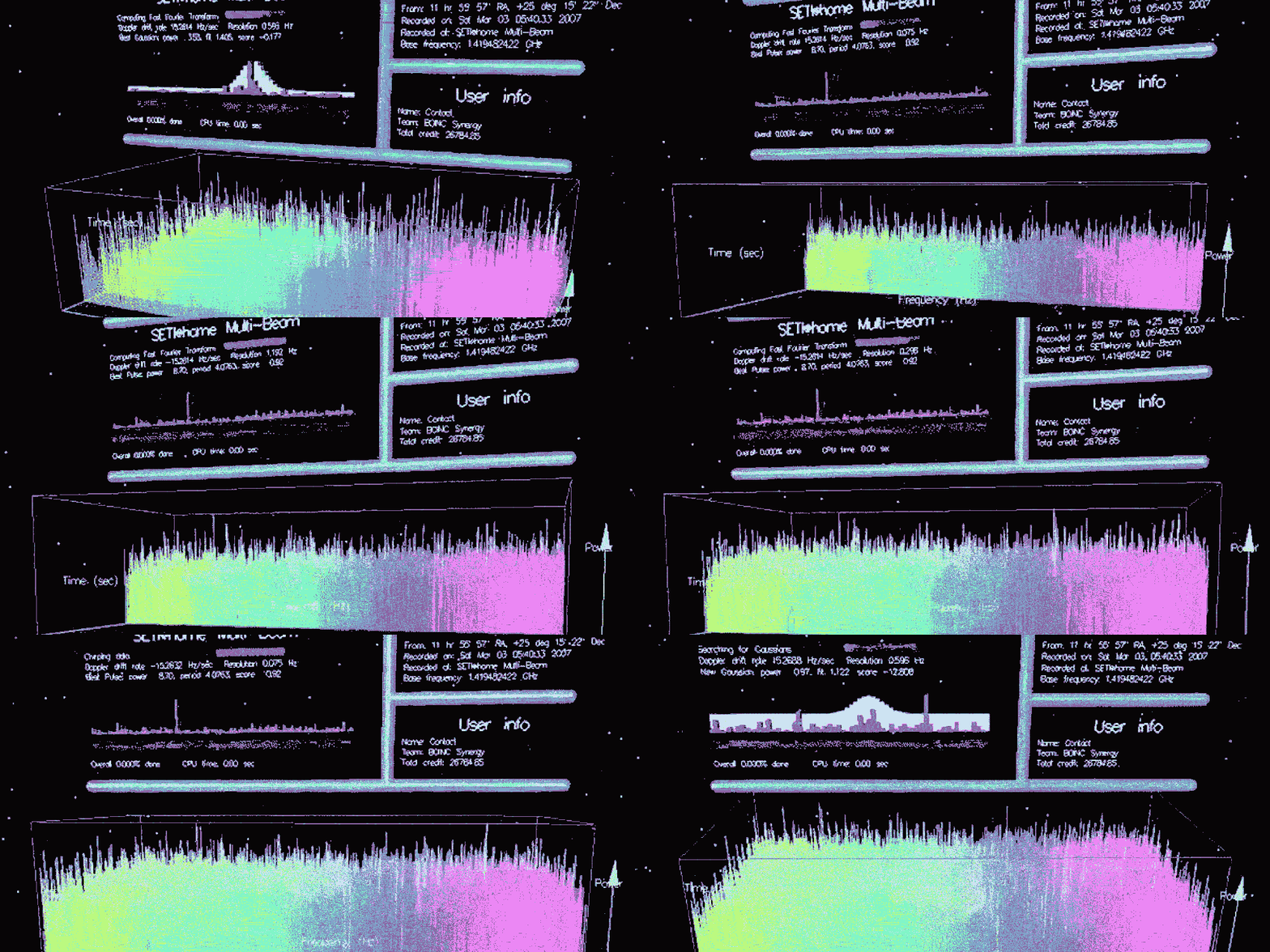
SETI@Home is coming back to life, in a way.
The project ran for 21 years from 1999 — essentially the dawn of the popular Internet — to 2020. Millions of people around the world gave up their precious home bandwidth to help the University of California, Berkeley-led team analyze potential alien signals.
Today, SETI is reanalyzing the 100 most promising signals from its SETI@Home project via follow-ups with the Five-hundred-meter Aperture Spherical Telescope (FAST) in China. The project has been gazing at these targets since July in hopes of spotting a repeat.
The FAST telescope performs a single scan across the previously identified signal candidate at a little faster than the rotation of the sky, using 19 beams to record the data. “This scan rate allows the SETI@home client to find all detection types,” such as spikes, the team noted in a recent research paper. Including the slewing time and the scan, which itself takes about 172 seconds to perform, each reexamination of the sky is brief: 15 minutes.
Eric Korpela, a research astronomer at UC Berkeley who led SETI@Home and is helping to helm the new research, said he hasn’t heard from his Chinese colleagues yet, which means there is nothing significant to report. Computers are faster these days, and telescopes are more sensitive, which means there is still hope.
“We're getting pretty far through that list,” said Korpela, who has been with SETI@Home since its original iteration in the 1990s.
Since the 100 signals have not generated anything since searches began in July, there is discussion to bring the project a step further. “We are thinking about pushing into a few more potential candidates,” Korpela said, but noted that the talks are at an early stage.
Getting to this point took a lot of work. Korpela and his team dove into the SETI@Home archive to see if they could find true signals from the stars among the billions (or, as the popular Carl Sagan paraphrase goes, “billions and billions” of candidates. Luckily, today’s AI allows much of the fine-tuning to take place by automation.
SETI@Home looked at signals that are not produced naturally.
As the recent research paper stated, the “range of target signals” is meant to have “characteristics typical of technological origin.”
“Specifically,” the investigators added, “we look for continuous narrowband signals whose power is concentrated in a small frequency band (< 1221 Hz), pulsed narrowband signals, also with bandwidths up to about 1221 Hz, that turn on and off with a constant but unknown period and duty cycle, and signals having a repeating structure with periods up to several seconds.”
The team immediately discarded obvious signals showing interference, such as signals that were at the same frequency but located at very different points in the sky. This was most likely some kind of satellite, and not a faraway signal, allowing such candidates to be quickly dropped.
“We look for signals that are transmitted over a long period, ideally our entire observation period, and with a high duty cycle. It is unlikely that we would detect a transient signal, one lasting a few seconds or minutes, because the probability that we would be observing its location during that period is small,” the research team stated in their paper.
Investigators also created a ranking system to find the most promising signals, and they did that by inserting what they believed were good examples of potential “extraterrestrial” signals into their data hunt. The goal was to put these signals in to see if their methods for finding the genuine, against the fake, actually worked. And once they knew they could find a generated extraterrestrial signal, any candidate signals were then measured against the mark.
While some of the work took hand-searching, it wasn’t as much as you would imagine. Korpela said he has confidence that the roughly 100 candidates that FAST is examining are robust. We can’t say for sure that this is E.T. calling home, but SETI terms the candidate signals “intermittent statistical outliers” because the signals only happened two or three times at about the same sky position.
SETI@Home arose from a “vast amount of data” for astronomers to analyze, Korpela said. And as computers got faster, he noted, we kept looking for more challenging sets of information. “There has never been a time when the computers that we have had available to us have been fully adequate to analyze that data.”
SETI@Home came to be when the Internet was much smaller.
As a person in my 40s, I'm old enough to remember the World Wide Web entering our house in 1997—and the wonders of being able to connect to anyone at any time, if at dial-up speed. I was one of the SETI project’s participants, often giving up my precious 30 Internet minutes a day (my family paid by the hour) to help with the hunt.
Korpela says SETI@Home was lucky to get its start before smartphones became popular, before social media surged, and before people began to disappear into filter bubbles just to make sense of it all. “SETI@Home really aired at the right time, for doing that,” he said of the project’s popularity. “If SETI@Home — if someone, if it hadn't happened, tried to start that now—just getting attention, yeah, would be very difficult.”
SETI Culture
In the late 1990s, popular alien movies were all over the theatres, although many of them were not friendly: Independence Day, Mars Attacks!, The Arrival, Men in Black, Alien Resurrection, and Galaxy Quest are just a few examples. But closest to the SETI project was Contact
Contact was far more of a niche film than Independence Day, a Will Smith-Jeff Goldblum blockbuster so popular that it formed early Internet memes and (eventually) an unworthy sequel. But as Korpela pointed out, if Contact was a niche film, so was the audience for SETI@Home.
Support Supercluster
Your support makes the Astronaut Database and Launch Tracker possible, and keeps all Supercluster content free.
Support“People who were interested in SETI tended to be more enthusiasts, rather than just the general public,” he said, and he said the advantage of the early Internet were people in general were not “as bombarded by information.” This made it easier, he said, “for the enthusiasts to contact their friends and say, ‘Hey, you've got to check this out.’”
Word of mouth proved powerful: hundreds of thousands of people signed up for SETI@Home in short order, he recalled, even before the software was fully released. But with rapid growth came challenges: the Internet was a “do-it-yourself” project at that time, forcing the founders to build their own forums. Capacity problems arose, as well as management ones, for so many volunteers.
Remember, this is taking place decades before social media — and even shortly before Google, and its forums. “There weren't as many places for people to find connection,” Korpela said. But on the other hand, he noted, “I think that sort of thing would be difficult in the era of social media, because people have already locked into their social media behavior.”