
If you’re an Artemis astronaut flying to the Moon, what do you anticipate needing to bring with you?
You — and several other spacefarers — only have 330 cubic feet to work with, and any additional mass will make the launch more expensive, so you must be picky. Obviously, you’ve got your next-generation spacesuit. You mustn’t forget to take your carefully packaged food (which these days can include barbecued beef brisket and broccoli au gratin). Make sure your science fiction-like experiments are brought along for the ride, too.
Oh — and whatever you do, be sure you’ve got your official spaceflight plushie. In the case of the Artemis II mission, this comes in the form of a fluffy little orb named Rise.
This little mascot, which is freely floating about along with the rest of the Artemis crew, is arguably one of the least essential components of NASA’s 10-day lunar slingshot. But it is easily the most endearing part of the entire endeavor, which in a way makes it just as important as anything else within the Orion spacecraft.
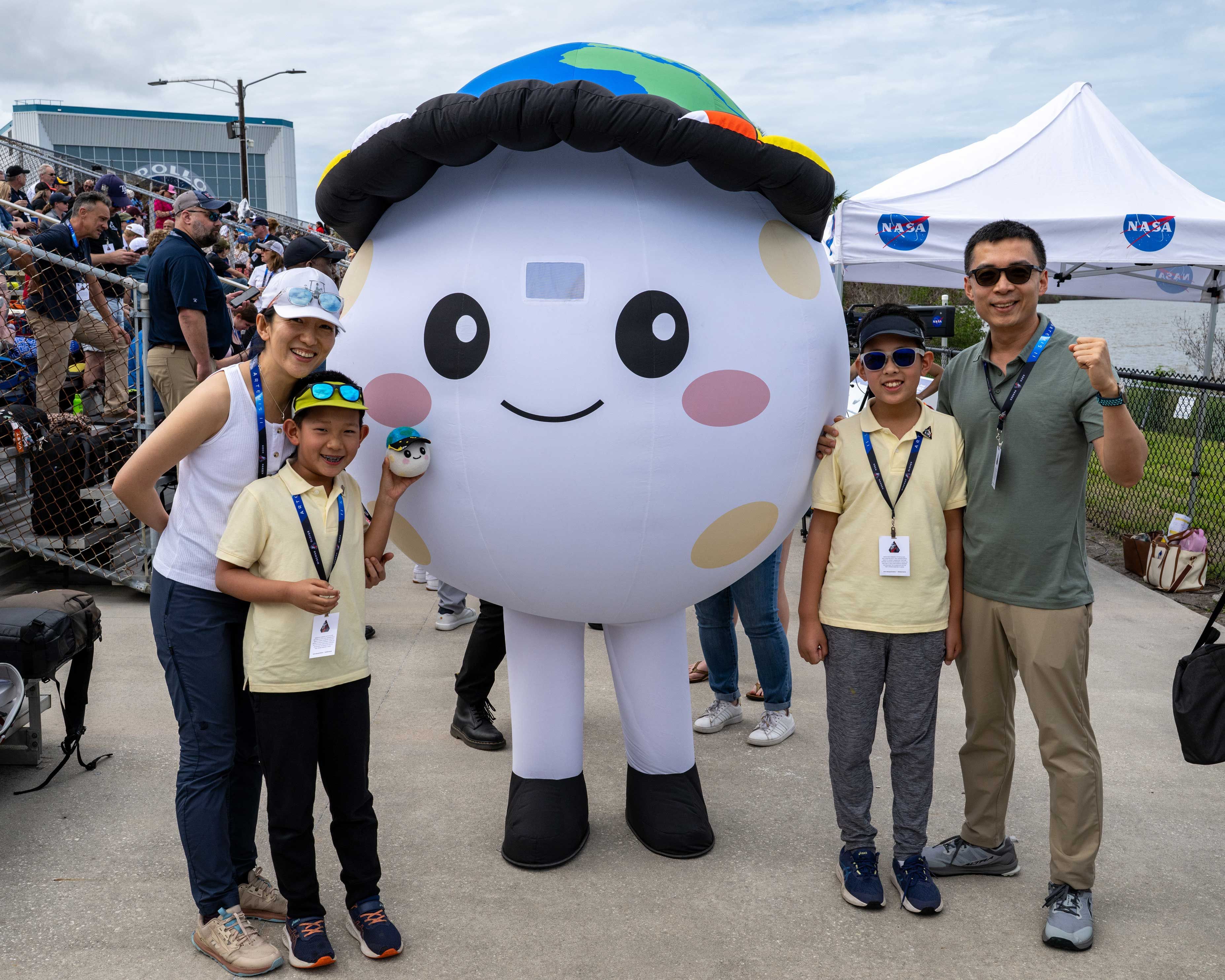
Lucas Ye, designer of zero gravity indicator “Rise,” and his family pose for a photo at the Artemis II launch. Courtesy of NASA.
Rise — a smiling simulacrum of the Moon wearing a very fetching hat, with a star-speckled visor and an Earth-themed crown — is objectively adorable. It was designed by Lucas Ye, an eight-year-old from Mountain View, California, as part of a NASA-led competition.
Along with crowdsourcing platform Freelancer, the venerable space agency asked the world: Hey, can you design a bijou plushie toy for the Artemis II crew to take aboard? Over three months, they fielded submissions from people from over 50 different countries, and as you might expect, a cornucopia of kids threw their hats into the highly competitive ring.
Last August, NASA declared there to be 25 finalists: a menagerie of critters, creatures, and moonwalkers. Some of them — like Lepus the Moon Rabbit, collectively designed by a school in Canada — looked very much like a rabbit-themed Pokémon. Another entry, this time from Finland, was an octopus-like astronaut with several planets held at the end of each tentacle. Moru, appearing to be a starstruck, sentient cloud, came courtesy of a hopeful from Japan.
But there was just something about Rise, the optimistic little lunar ball, that won the judges over. And just a few days before Artemis II blasted off into space, it was announced as the winning design. The mission’s four astronauts — shades on, and standing in front of some flashy jets at the Launch and Landing Facility at NASA’s Kennedy Space Center — posed with Rise under the Floridian sun. Everyone looked positively thrilled to be there, together.
Spaceflight mascots aren’t new; plenty of uncrewed missions have them.

The planetary defense mission, NASA’s Double Asteroid Redirection Test, or DART — which punched an asteroid in the face to prove that space rocks could be swatted away from Earth — had a pleasingly geeky one. Being hardcore Star Wars fans, the spacecraft’s ground controllers crafted a desktop plushie they named DART Vader: a baffled-looking miniature version of the infamous Sith. And the Artemis I mission, which flew a vacant Orion capsule through space to test out its systems in 2022, had a little spacesuit-wearing Snoopy toy on board.
Aside from being rather charming, why exactly does NASA bother to put plushies aboard spacecraft? Officially, they are known as zero-gravity indicators, or ZGIs. As NASA itself notes, ZGIs “provide a visual indicator when a spacecraft has reached the weightlessness of microgravity.”
I know what you’re thinking: surely it’s blindingly obvious to everyone both below and above the firmament when a spacecraft gets to space. Yes, that’s true; NASA likes to have a little toy demonstrate that fact to anyone watching on the spacecraft’s internal cameras.
Reid Wiseman, the commander of Artemis II, has previously sojourned on the International Space Station — and he brought his own ZGI with him, a little toy giraffe. This was gifted to his oldest daughter by Wiseman’s mother, and his children insisted he take the vertiginous beastie — affectionately named Giraffiti — to low-Earth orbit. Another astronaut aboard the ISS, Karen Nyberg, made her own ZGI, a stuffed dinosaur, from an old T-shirt and scraps of food packaging.
Rise, then, is the latest participant in this tradition. But this ZGI is novel for a bunch of reasons. There’s an SD card inside Rise — one that contains millions of digitized names of people from all over the world, who submitted them as part of the Send Your Name to Space campaign.
And this marks the first time NASA wanted the public — largely, children — to pitch their own ideas for a ZGI. And it was truly wonderful seeing the Ye, the triumphant kid, at the actual Artemis II launch itself, become instantly giddy when asked about his winning design on live television. How did he feel when he was told his handful of Earth was going to boomerang around the Moon? “Really, really, really, really, really, really, really, really surprised,” he said, through an explosive grin. “And very happy.” Ye and his family were also greeted at Kennedy by the surreal sight of a person in a Rise mascot suit.
NASA is doing all it can to engender public interest and investment in its much-trumpeted return to the Moon, the first step in what will be a transformative effort to turn Earth’s silvery companion into a permanently inhabited place. The Artemis II ZGI is a very small part of that campaign, but it already suggests that today’s younglings, born long after the Apollo era, are acutely aware of the emotive power of spaceflight.
Rise isn’t just cute.
It’s a nod to Earthrise, an image taken in 1968 during the Apollo 8 mission. As the spacecraft swung around the Moon, Earth — a captivating swirl of white and inky blue — precipitated out of the cosmic darkness. Astronaut William Anders captured the breathtaking sight on camera, and in doing so, created one of the most impactful, iconic photographs in human history.
That Ye and his family were thinking of that iconic image when they designed Rise is particularly uplifting. It suggests that spaceflight milestones echo through time, inspiring people decades after they happened.
Support Supercluster
Your support makes the Astronaut Database and Launch Tracker possible, and keeps all Supercluster content free.
SupportAt the time of publication, the Artemis II spacecraft will have just completed its historic flyby of the Moon. Its four astronauts glimpsed parts of the shadowy lunar farside never seen by human eyes. Already, the mission has generated an abundance of iconic imagery, from an aurora-wreathed Earth to the crater-speckled desert of our planet’s natural satellite.
On April 7, humanity got to look back at itself through Earthset, a new shot of the planet dissolving into the galactic night behind the Moon. The power of this image doesn’t come from its echoing of Earthrise; instead, it’s that it highlights that space exploration, something that was truly extraordinary back in 1968, is soon to become wonderfully, gloriously ordinary.
But among these expansive photographs of our corner of the solar system, there’s still a place for the myriad smaller moments captured on film, too. Rise can often be seen floating gleefully in front of, and in the care of, mission specialist Christina Koch — although the ZGI is frequently passed between each of the astronauts like a weightless, fuzzy baton.
Voyaging through space is a serious ordeal.
The capacity of our species to survive long into the future likely depends on it. But the footage of Rise bouncing around the astronauts’ living quarters makes a powerful statement all in itself: If you can’t have a bit of lighthearted, goofy fun while journeying to the Moon and back, why bother going in the first place?
...
Rise is included among the Artemis II mission in Supercluster's Astronaut Database, a tradition that was started when Crew-1 launched with Grogu, and we were cyber-bullied into adding him.