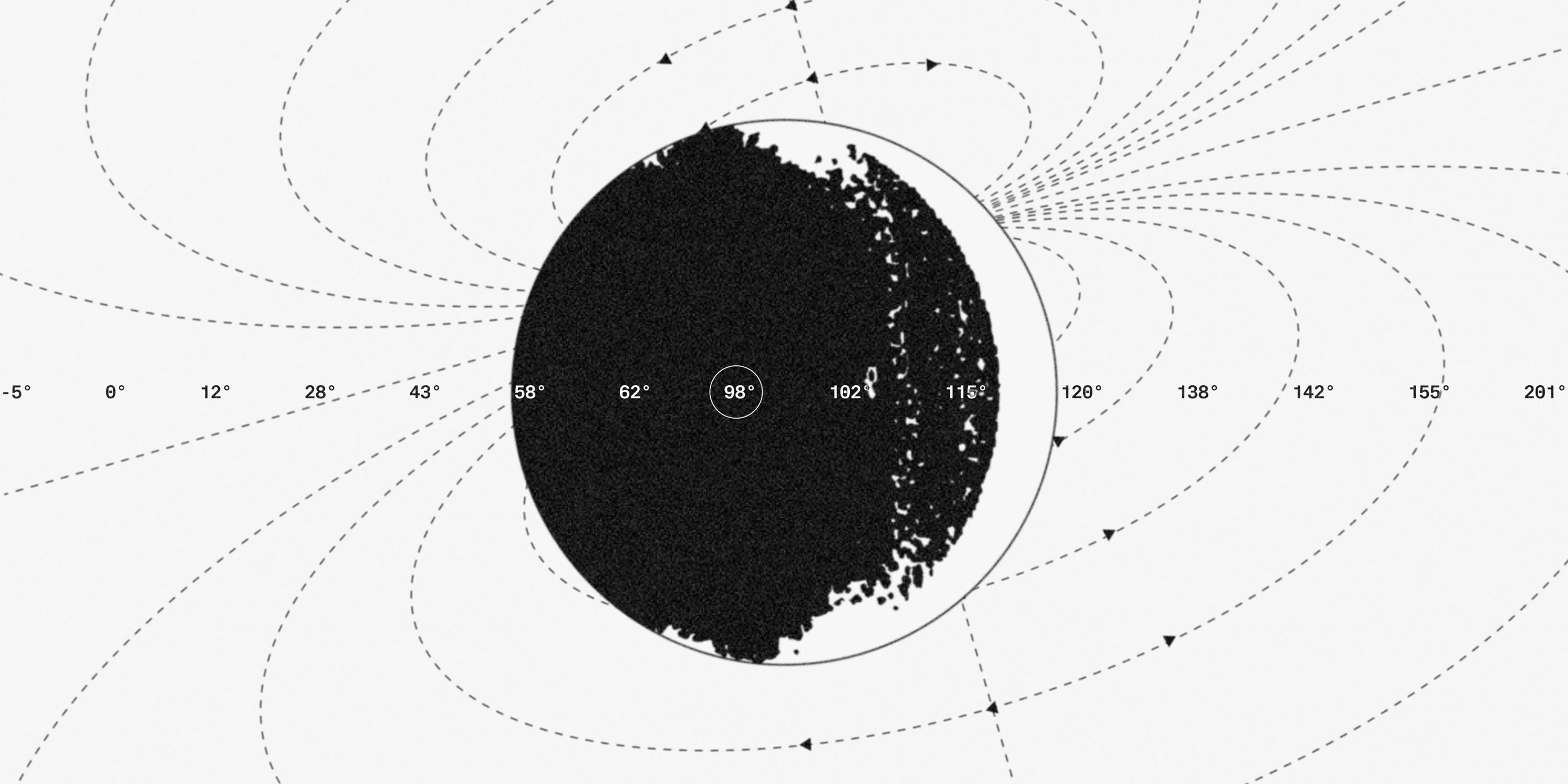
The planets of the Solar System all orbit around the Sun like spinning tops, stood up on their rotational axis.
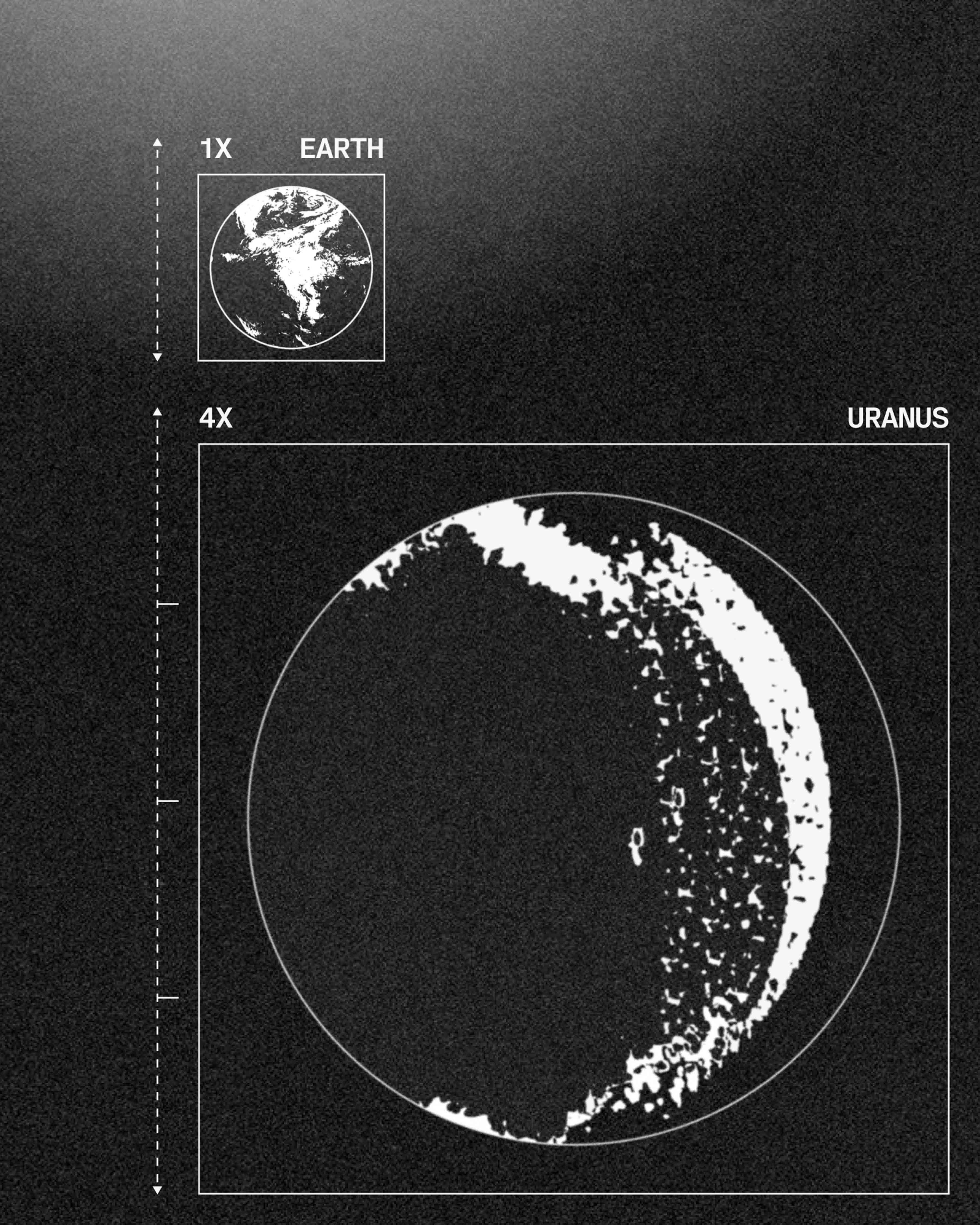
All, that is, except for one. Out there, in the middle-distance of our Solar System, is a planet that orbits the Sun while tilted almost 98-degrees onto its side. It is Uranus, fourteen times more massive and four times as large as our Earth. What the heck could have done this to such a huge planet?
This, and others, are the mysteries that are drawing us back to Uranus once again.
“Planetary science is about exploration,” says Adam Masters, an associate professor of planetary science at Imperial College in London. “And Uranus is at the frontier.”
Our only encounter so far with this enigmatic world came forty years ago, on January 24th, 1986, when the Voyager 2 spacecraft went boldly where no one had gone before. The anniversary of this historic flyby allows us to reflect on one of the most famous missions of exploration in human history, and look forward to our future exploration of this beguiling planet.
I hadn’t been born when the twin Voyager probes flew past Jupiter in 1979 on the first leg of their mission, and was but an infant when they encountered the ringed wonder, Saturn, in 1980 and 1981. At this point the Voyager probes went their separate ways. Voyager 1 headed directly for interstellar space, while Voyager 2 continued its onwards march to the planets, with its rendezvous at Uranus becoming the first planetary encounter that I watched happen in real time as a child. Consequently, it has always stuck with me.
How did Voyager 2 reach Uranus?
In 1962 a grad student by the name of Michael Minovitch developed the mathematics of the gravity assist technique while on a summer placement at NASA’s Jet Propulsion Laboratory. By transferring some of a planet’s orbital momentum to a spacecraft entering its gravitational field, the gravity of that planet could be used to slingshot the spacecraft away at higher velocity. By doing so, the gravity assist technique meant that missions didn’t have to carry as much fuel as they otherwise would, and would therefore be less expensive to launch.
A few years later another student at JPL, Gary Flandro, identified a possible trajectory based on Minovitch’s work that capitalized on a rare alignment of the outer planets. This alignment would allow a mission launched in 1977 to first head to Jupiter before being slingshot onto Saturn where it would gain another slingshot to Uranus followed by a final gravity assist to put it on course for Neptune. It was a huge opportunity because that particular alignment of planets only happens every 175 years. It was a huge stroke of luck that it would come just 20 years after the dawn of the Space Age.
The Voyager missions were the result, or more specifically, Voyager 2 was. NASA didn’t want to commit to two lengthy missions to all four planets, so while Voyager 1 checked out of planetary exploration after Saturn, Voyager 2 had launched two weeks before its twin to enable it to take advantage of Flandro’s alignment.
The Opposite of Boring
Saturn had been visited previously by Pioneer 11, but Uranus was new ground. Two-point-nine billion kilometers from the Sun, Voyager’s imaging technique had to be adjusted to compensate for light levels that were only a quarter of what the mission had experienced when it flew past Saturn.
As the first close up images of Uranus and its moons were beamed back to Earth, excitement soon turned to mumblings of discontent. Whereas Jupiter and Saturn displayed active, writhing atmospheres with turbulent storm clouds that, in Saturn’s case, was topped off by the most remarkable ring system, Uranus appeared visually bland and boring, swamped in a featureless blue–green smog and encircled by dark, thin rings that were barely visible. I still remember young me, sat in front of the TV, feeling the distinct sense of dismay emanating from planetary scientist talking heads on the screen.
Yet Adam Masters strongly disagrees with the narrative that Voyager 2’s flyby of Uranus was a disappointment.
“Uranus as a system is a lot richer in scientific potential than it first appeared,” Masters tells Supercluster. “Uranus is the opposite of boring, it’s probably one of the least boring planets in the Solar System because we know so little about it.”
Before Voyager 2 reached Uranus, we knew of five of its moons, named after characters from the works of William Shakespeare and Alexander Pope: Ariel, Miranda, Oberon, Titania and Umbriel. Nine dim, dark rings had been identified in 1977 thanks to stellar occultations during which astronomers observed stars winking out as the ring system passed in front of them, at the same time as Voyager 2 was being prepped for launch. During its flyby, Voyager 2 discovered eleven new moons (astronomers have since found a total of 29 Uranian moons, the most recent, a 10-kilometer moon too faint to have been detectable to Voyager 2, coming in August 2025 courtesy of the JWST) two new rings (we now know there are 13) and took 7,000 images in total, starting on 4 December 1985 when science observations began from a distance. The closest Voyager 2 got to Uranus was 81,600 kilometers above the bland blue–green hue of the planet’s atmosphere.
We also knew that Uranus is unique among the worlds of the Solar System in that something had tipped it onto its side, resulting in Uranus giving the impression of rolling around the Sun.
Weird Stuff Going On
That in itself makes Uranus utterly fascinating, and you would think that finding out what is powerful enough to knock over an entire planet would be high on the list of planetary scientists’ aims.
“It’s very odd,” says Masters of Uranus’ tilt. “There are different ways to do it, including a giant impact.”
Uranus’ extreme tilt, and the repercussions of that tilt, factor into much of the planet’s properties as measured not only by Voyager 2 but also subsequently by telescopes on Earth such as Keck and by the Hubble and James Webb space telescopes. The cause of the tilt is also potentially integral to many of the unanswered riddles that Uranus still poses.
For example, all the giant planets emit more heat from their interior than they receive from the Sun, with one exception, and you probably don’t need me to tell you which planet is the exception. Voyager 2’s infrared interferometer spectrometer measured the planet’s emissions in the far thermal infrared, finding it to radiate just 1.06 times the amount of energy that falls onto it from the Sun.
“There’s something weird going on,” says Masters. “All the giant planets give off excess heat except for Uranus, and we don’t really understand why. Uranus has very different atmospheric dynamics, a very different energy budget deep inside the planet.”
One possibility is that the proposed impact that whacked Uranus onto its side also smacked out most of the planet’s internal heat in one big shockwave. Another proposal is that there is some kind of barrier somewhere deep inside Uranus that prevents heat from leaking out. Frankly, we just don’t know. We do know that it’s not a trait of ice giants — when Voyager 2 reached Neptune in August 1989, it found plenty of excess heat radiating out from the azure blue planet.
Magnetic Mysteries
Another mystery discovered by Voyager 2 is the bizarre nature of Uranus’ magnetosphere, but it’s a mystery that’s now beginning to be resolved. Voyager 2 measured a compressed magnetosphere around Uranus, a puzzling lack of plasma confined in that magnetosphere, and supercharged electron radiation belts. Uranus’ magnetic field is also strangely off-center, the heart of the magnetic dipole found a third of the way from center of the planet to the south pole. It’s also out of kilter with Uranus’ rotational axis by 59 degrees. This unexplained misalignment of the magnetic field does seem to be a trait of ice giants; Neptune also has a magnetic field that’s rotated 47 degrees to the planet’s rotational axis and which is also off-center.
During the flyby in 1986, Voyager 2 measured the solar wind to be of unusually high pressure, perhaps resulting from a coronal mass ejection on the Sun, and which would have compressed the magnetosphere. Masters describes how these measurements are now being revisited by contemporary scientists who have mined archive data from multiple instruments on Voyager 2 — the likes of its magnetometer, its plasma spectrometer and its low-energy charged particle instrument — to make new discoveries 40 years after the flyby.
Support Supercluster
Your support makes the Astronaut Database and Launch Tracker possible, and keeps all Supercluster content free.
SupportThe new study, led by Robert Allen of the South-west Research Institute, found that the compression of the magnetic field had temporarily squeezed all the plasma out of the planet’s magnetosphere. They also found that the solar wind disturbance that had instigated the compression in the first place had been able to dump a whole bunch of electrons into Uranus’ radiation belts.
“We knew from the Voyager era that the solar wind was of unusually high pressure,” says Masters. “Attention has once again been drawn to that, but the key thing is people are now showing how it can explain things such as the varying intensity of the electron radiation belt.”
Return to Uranus
Nothing like resorting to 40-year-old data screams the need for new observations and new information. Now, at long last, there is hope for a new mission on the horizon.
“There’s so many mysteries that we’ve been pushing for a new mission for years,” says Masters. “And now we sort of have one. There’s a long-term plan for a new flagship mission to Uranus.”
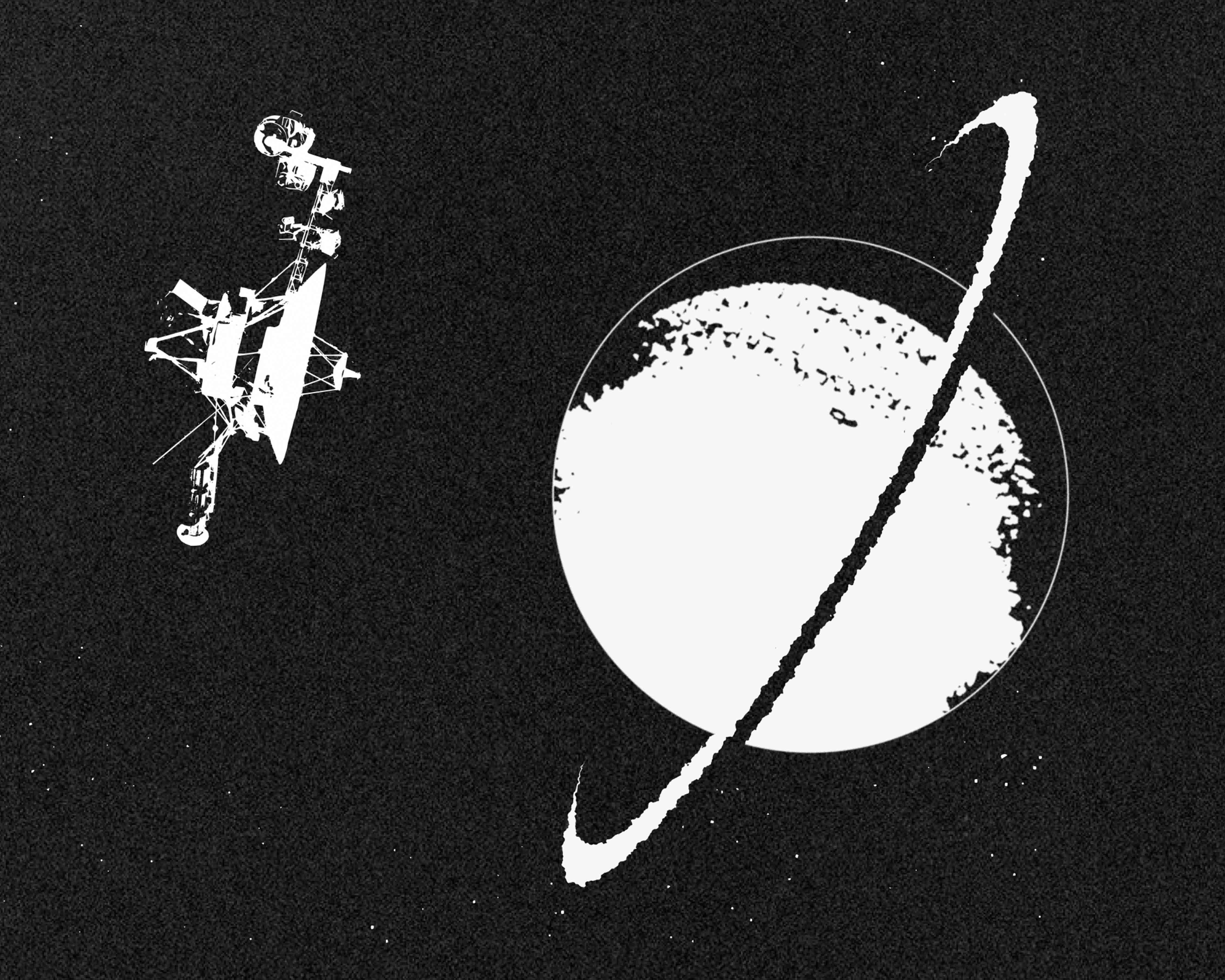
That flagship mission is an orbiter that was declared a top planetary science priority in the most recent Decadal Survey by the National Academies in the United States. Ordinarily that would man it would be a surefire bet to go ahead, but the current political direction of the United States does place a question mark over the mission.
Assuming the new mission does go ahead, how different will an orbiter be to a flyby mission such as Voyager 2? The main difference is perhaps the most obvious — whereas Voyager 2 spent a scant few hours zooming past Uranus, an orbiter can be there for years, and that’s important because there are indications that Voyager 2 encountered Uranus at a time that was somewhat atypical for the planet.
“Did Voyager 2 catch Uranus at a bad time? It depends upon which aspect of Uranus you’re trying to understand,” says Masters. “For some aspects of Uranus, anytime is a good time. But there are other aspects that are more dynamic, and then you can see how the timing might not have been ideal.”
We’ve already seen how this was the case with Uranus’ magnetosphere, but it may also have been the case with the planet’s atmosphere too. While image enhancement showed underlying details and infrared observations detected some activity, in visible light the atmosphere looked pretty dead. However, beginning in the 1990s with observations by Keck and Hubble, astronomers began to see activity — bands and storms and a smoggy halo over the visible pole.
“Uranus isn’t as dead as it appeared in Voyager’s visible, un-enhanced images,” says Masters.
A new mission would aim to arrive at Uranus in time for the equinox in 2049, when both hemispheres of the planet will receive equal sunlight and the rings are edge-on to the Sun. The equinox will introduce a whole new seasonal change, which we have previously observed from a distance during the previous equinox in 2007 with telescopes on or around Earth.
Prime Time for Uranus Science
The year 2049 sounds like a long time into the future, but on the typical timescale of planning, developing and launching such a mission, and factoring in travel time, it’s not so long.
“The hope is to launch in the next 10 to 15 years, so we really have to get started,” says Masters, who is part of the science definition team for the mission. That launch date is ambitious — the mission doesn’t even have the official go-ahead from NASA yet — and the situation in the United States raises some doubts.
But why has it taken so long just to reach this stage?
Masters puts it down to a number of factors. One is simply that Uranus has had to wait its turn for an orbiter. We’ve had flyby missions to Jupiter, Saturn, Uranus, Neptune and Pluto in that order, and several orbiters to Jupiter and Saturn, spurred on in part by the discovery of their ocean moons and the potential for habitability making them priority targets and consequently bumping a Uranus mission back down the list.
“Without those big discoveries maybe we would have had a Uranus orbiter by now,” says Masters.
Another factor is the technical challenge of powering a mission so far from home. Jupiter is still close enough to the Sun that missions to the Jovian system, such as NASA’s Juno and the European Space Agency’s JUICE, can utilize solar power with large solar arrays. Beyond Jupiter, however, sunlight grows too feeble in line with the inverse-square law, and so nuclear power is required instead. This is in the form of RTGs — radioisotope thermoelectric generators — but RTGs don’t grow on trees; it takes time to obtain and refine the plutonium that powers them. Masters says that how soon the Uranus orbiter mission can launch “depends on the availability of RTGs.”
Once launched, however, the mission is unlikely to use a Jupiter gravity assist, since having to wait for Jupiter and Uranus to become aligned creates too many constraints on when the mission can launch. This is somewhat ironic considering how Voyager 2 took advantage of gravity assists. Instead, the Uranus orbiter would launch on a big, powerful rocket that would hurl the mission towards the ice giant.
Between now and then, interest in Uranus is ramping up. “In recent years there has been a resurgence of interest in Uranus because of the future mission,” says Masters. This can be seen in the new studies of Uranus’ magnetosphere and the discovery of new moons. “Now is actually prime time for Uranus science because we’re defining the science for the flagship mission.”
With luck, we’ll see that orbiter arrive at Uranus within our lifetimes, and welcome answers to the mysteries that have held planetary scientists spellbound for forty years and counting, fulfilling the legacy of Voyager 2.