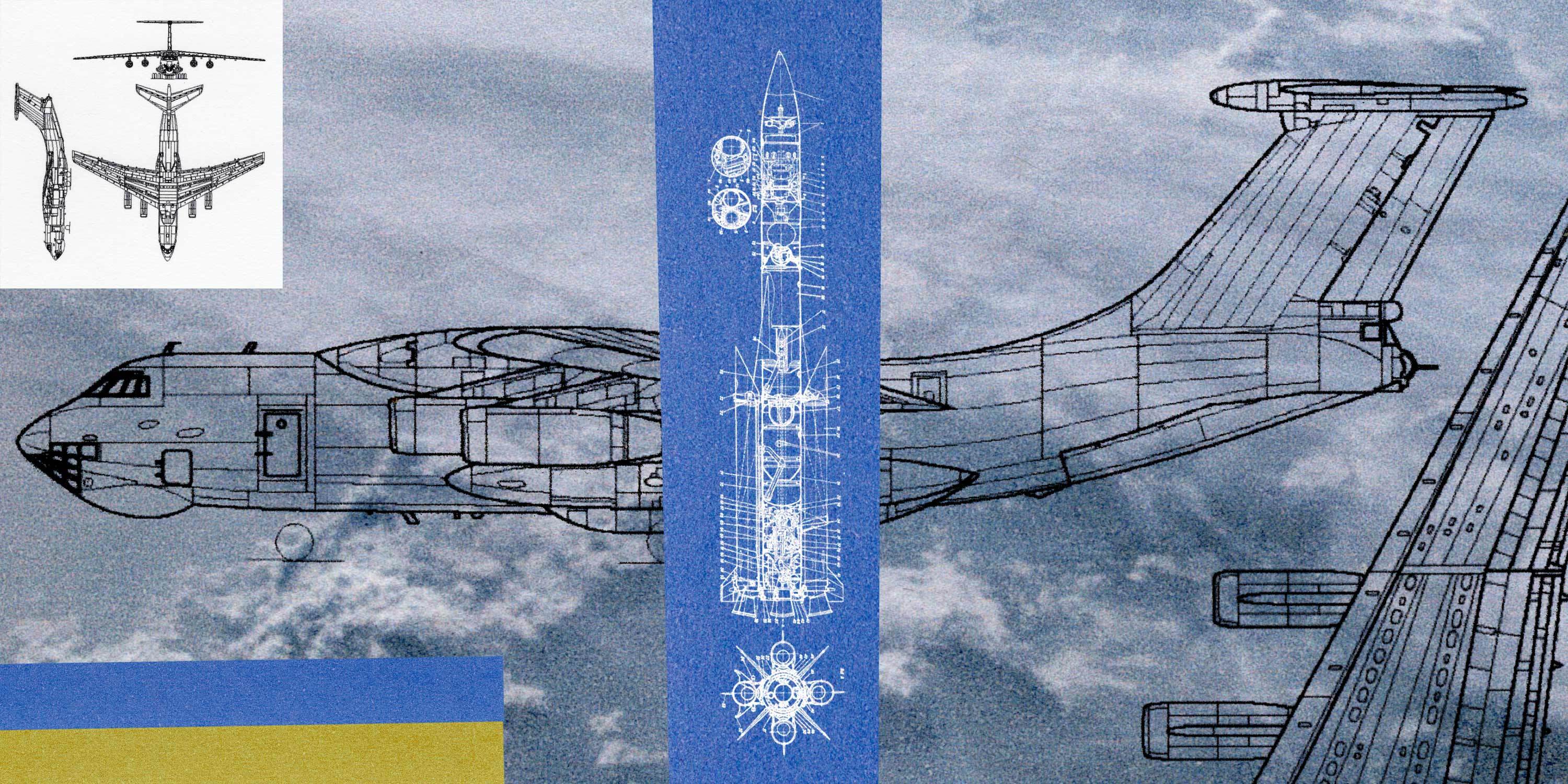
Ukraine is testing an air-launched rocket.
And may be able to achieve orbital flight by the end of this year, potentially beating a peloton of Western European space start-ups that have been trying for years to get small satellite launchers off the ground.
The development was first disclosed in mid-April by Fedir Venislavskyi, the head of the Ukrainian parliament's subcommittee on state security, defense, and defense innovations, and is spearheaded by a company called Orbit Boy, a spin-off from the Ukrainian Space Agency.
Supercluster spoke with a source from inside the company, who didn’t wish to be named, for some insight. Venislavskyi’s comments, as it turns out, were not exactly accurate.
The lawmaker said that Ukraine had launched two rockets to space from a flying carrier a few months ago. The source, however, said that only a drop test of an engineering model of the rocket from aboard a plane had been conducted, plus two sub-orbital test launches of the actual rocket from the ground.
These experiments took place in late 2025, and the company hopes to attempt its first air launch to orbit in collaboration with the Ukrainian military by the end of 2026.
“We tested the air drop technology process, which was successful, and separately, we did two suborbital launches, vertically from the ground, which exceeded the altitude of 200 kilometers [124 miles], in order to test the propulsion systems, all the avionics, everything,” the source said. “That was the step before we will be able to launch into space from the plane.”
For the airdrop test, a Ukrainian-made mid-range Antonov-70 aircraft owned by the Ukrainian military lifted the engineering model of the rocket to an altitude of 5,000 meters, where an onboard engineering team released the mock-up from the fuselage. During the test, the team collected data to confirm the mock-up rocket behaved as expected as it slid out of the plane and hurtled through the air.
The Orbit Boy team has been developing the system since before the Russian invasion in 2022, building on Ukraine’s rich legacy in space technology research and development.
“The development was ongoing as part of a private initiative starting in 2021,” the source said. “Then the war started, and we were not able to raise any funding, so we were moving slowly with our own resources, one step at a time. And then, as we got closer to being able to do the tests, the situation changed, and Ukraine was in need of access to space.”
Little-Known Space Power
Ukraine played a key role in the Soviet era space program. Not only was Sergey Korolev, the brain behind the USSR’s 1960s space exploration successes, born and educated in Ukraine, but the Yuzhmash/Yuzhnoye rocket factories in Dnipro (renamed to Pivdenmash in the 1990s), in central Ukraine, used to manufacture about a third of all USSR-made launchers and missiles.
Before the Russian invasion, Pivdenmash used to supply first stages for Northrop Grumman’s Antares rockets that launch the Cygnus cargo vehicle to the International Space Station. Italian rocket maker Avio still purchases fourth-stage engines for its Vega C rocket from Pivdenmash, despite initiatives to develop an alternative in European Space Agency member states.
This legacy has enabled the Orbit Boy team to move forward at a rather mind-boggling speed despite the ongoing siege by Russia.
“We build on the heritage, which originates from the Ukrainian space program, and even earlier, from the Soviet space program, which Ukraine was a major part of,” the source said. “Ukrainians have been involved in so many developments, and the majority of them were never commercialized.”
The war state, in fact, provides a considerable advantage in the testing process, enabling the team to move faster than most Western counterparts can. Ukraine’s airspace is closed to commercial aircraft. Moreover, launching rockets in the direction of another country — Russia — something that in times of peace would be unthinkable, is not of concern. Russian missiles have been raining daily on Ukrainian cities and infrastructure for more than four years now.
“Now it’s much easier on the regulatory part to do launches from the territory of Ukraine,” said the source. “You just launch whatever you want in the Russian direction and fly it. No limitations anymore, which means you can do tests more quickly.”
Where Virgin Orbit Failed…
Orbit Boy uses the same concept as the now-defunct Virgin Orbit, a sister company of Sir Richard Branson’s space tourism venture Virgin Galactic. The California-headquartered small launcher provider went bankrupt in 2023, three months after a failed launch of its LauncherOne rocket from the UK.
The Orbit Boy source, however, thinks the Ukrainian start-up has a good shot at succeeding where the widely publicized American company didn’t. In addition to building on decades of state-funded research and development, Ukraine has also proven over the course of the war that it can accomplish advanced technological projects at a fast pace and at a fraction of the cost required by Western counterparts. With a GDP per capita of only $6,980 compared to the European Union’s average of $48,651 and the U.S. $94,430, Ukrainian tech developers benefit from the low cost of labor (the average salary in Ukraine is around $700 monthly).
“For what we can deliver with ten or twenty million euros [$12 to 24 million], western European or US companies require like a billion or two billion,” said the source.
The Orbit Boy design is simpler and more flexible compared to Virgin Orbit, offering an easier path for scaling up operations. While Virgin Orbit’s 21-meter-long (70 feet) Launcher One rocket could only be launched from a customized Boeing 747, Orbit Boy’s 12-meter, 14-tonne small satellite launcher can be dropped from a wide range of mid-range aircraft, including Antonov-70, Airbus 400, or Boeing C-17.
Where Virgin Orbit’s carrier plane devised a suspension system to carry the rocket underneath the plane’s wing, Orbit Boy’s microlauncher can simply be released from inside the plane with the assistance of a team of engineers. The three-stage rocket, capable of launching satellites up to 400 kilograms in mass, uses solid fuel stemming from Soviet era research, instead of the liquid fuel relied on by Virgin Orbit.
That, the source added, simplifies storage and launch preparations.
“We are using a proprietary solid fuel formula based on fuel that was used for Soviet missiles.”
“The rocket is always ready, and it can be stored in the warehouses for almost 10 years without degradation of the fuel. The liquid fuel was an issue for Virgin Orbit because if they wanted to launch, they needed to have all that infrastructure to fuel the tank.”
Virgin Orbit LauncherOne ran on Rocket Propellant-1 (RP1), a highly refined form of aviation fuel kerosine, and liquid oxygen (LOX). Liquid oxygen is a tricky material to deal with as it’s highly flammable and needs to be stored and handled at temperatures of around minus 297 degrees Fahrenheit (minus 183 degrees Celsius).
Dark Horse
Our source thinks Orbit Boy might be ready to begin commercial operations in less than two years. Currently, only two small satellite launchers — Rocket Lab’s Electron and Firefly's Alpha are up and running. A peloton of runner-ups in the U.S., Europe, and elsewhere has been struggling for years to get their businesses off the ground.
In Europe, Spain’s PDL Space, Germany’s HyImpulse, ISAR Aerospace, and Rocket Factory Augsburg, France’s Latitude and Maia Space, and the U.K.’s Skyrora have been promising to begin launching for years. Another U.K. venture — Orbex, which was developing a sustainable rocket powered by renewable biogas — entered administration earlier this year. It may not be the last to not make it through the finish line.
“Europe needs access to space and literally doesn’t have it,” said the source. “I don’t think ArianeSpace can provide all the needed capability. We think we can deliver, and in the current geopolitical context, having such a solution in Europe is quite important.”
Support Supercluster
Your support makes the Astronaut Database and Launch Tracker possible, and keeps all Supercluster content free.
SupportArianespace, currently Europe’s sole launch provider, operates the heavy-lift Ariane 6 and the light-weight Vega C. Up until the mid-2010s, the company was a leader in the global launch market, but has lost heavily to SpaceX since.
Today, Europe largely relies on SpaceX to get its space assets to orbit.
In the past, Arianespace had a partnership with Russia to launch Russia’s Soyuz rockets from the European spaceport in Kourou, French Guiana. But with Russia now threatening European security, the latter partnership is gone. Relationships with the U.S. have also been getting sour since the beginning of Donald Trump’s second presidential term.
Air Launch
Opting for an air-launch system instead of a ground-based launch pad has significant advantages in densely populated Europe, Orbit Boy thinks. The aircraft carrying the rocket can take off from anywhere and head anywhere, to launch from the best location to reach the best orbit for any given purpose.
“When you launch from the ground, you are limited by your geographical position or your spot on Earth, and that limits your inclinations and orbits,” the source said. “When you do an air launch, there are no limitations.”
In the more than four years since the war started, Ukrainian technologists proved their ingenuity, ushering in a new wave of warfighting tech. What started with simple tweaks to consumer-grade drones to replace heavy artillery that the country was lacking grew into a vast, fast-paced innovation ecosystem.
Will this translate to the space domain? Orbit Boy is about to find out.
….
Editor’s Note: Supercluster’s design wing, Space Agency, produced two short films for Virgin Orbit, one explaining the concept through animation and a live-action short revealing the LauncherOne factory in Long Beach, California.