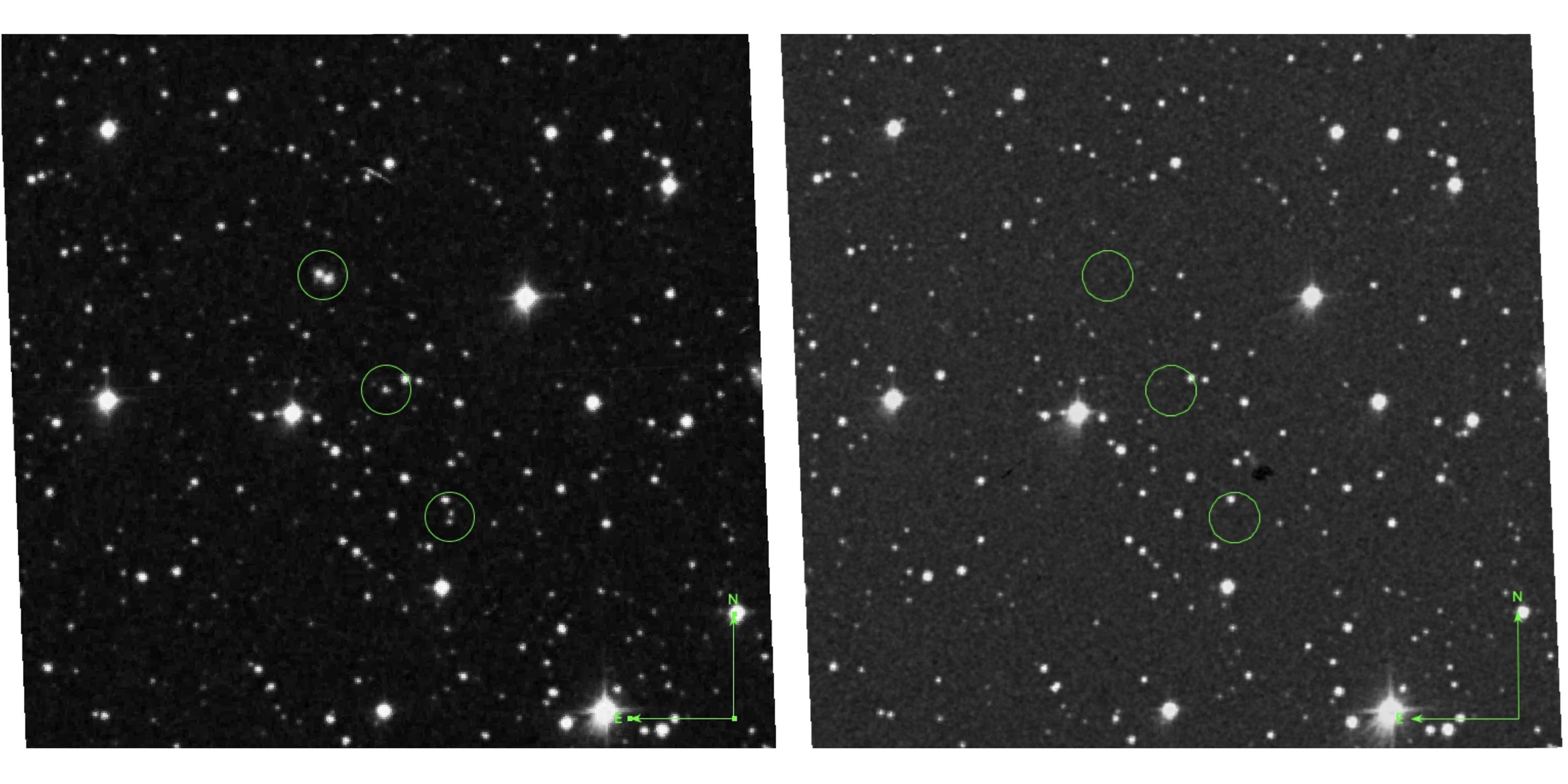
Transient flashes – momentary light bursts, circled in green – seen in a digitized astronomical plate from the Palomar Sky Survey on July 27, 1952. Note that the transients disappear in the 2nd image. Image via Villarroel et al./ Publications of the Astronomical Society of the Pacific.
When I was a teenager, I was a keen UFO believer.
There’s no shame in admitting that; Carl Sagan was too at a similar age. I’d even say it’s healthy at that age, a symptom of an interest in the Universe, a strong imagination, a sense of wonder, a hope that there’s more to the cosmos than what we see.
At university I learned to study phenomena objectively, critically and rationally via the scientific method. Hypotheses had to be tested to within an inch of their life to prove they were valid. Strange lights in the sky, stories of abductions, all the things that make up the bulk of UFO mythology suddenly seemed explainable in conventional terms. My sense of wonder about alien life transformed into an interest in SETI, the search for extraterrestrial intelligence.
Yet, whenever I see an unidentified light in the sky, though I know it is something mundane such as an aeroplane or satellite, a little part of me still wants it to be aliens.
So when Beatriz Villarroel of Stockholm University, who leads the VASCO (Vanishing and Appearing Sources during a Century of Observations) project, found anomalous objects on digitized versions of old photographic exposures of the night sky taken by the 48-inch Samuel Oschin Telescope at California’s Palomar Observatory in the 1950s, I was naturally intrigued. VASCO is designed to search for transient objects, of which there are many in the Universe – flare stars, tidal disruption events, novae and supernovae, and more – that appeared on the plates back in the 1950s but which aren’t visible now, or vice versa.
In my previous article, I described how Villarroel began to find star-like objects that appeared on one plate, but not on the one taken immediately before, nor the one taken immediately after. Astrophysical objects shouldn’t appear and disappear that quickly. On some plates, up to nine transients appeared at the same time. One might expect a plate to contain one astronomical transient, but nine all at the same time?
It seems unlikely.
Villarroel proposed that these transients are instead artificial, metallic objects in orbit around Earth, glinting in the sunlight. The thing is, these plates were exposed before 1957 and the launch of the first orbital satellite, Sputnik 1. If these things that Villarroel is finding on the plates really are satellites, then they are not ours. She speculated that perhaps they were the remains of ancient alien satellites that had come to inspect our world long ago, but were now tumbling around the Earth. This hypothesis fit in well with some of SETI’s speculations about Bracewell probes.
Thousands of Transients
Now Villarroel is back with new findings that dramatically increase the scale of the phenomenon that she believes she has found.
“We have identified approximately 107,000 transients across 635 plates,” Villarroel tells Supercluster. Given that each plate covers a small area of sky of about six square degrees, “a rough back-of-the-envelope estimate, with large uncertainties, is that we are talking about tens of thousands, to perhaps a few hundred thousand, interesting objects.”
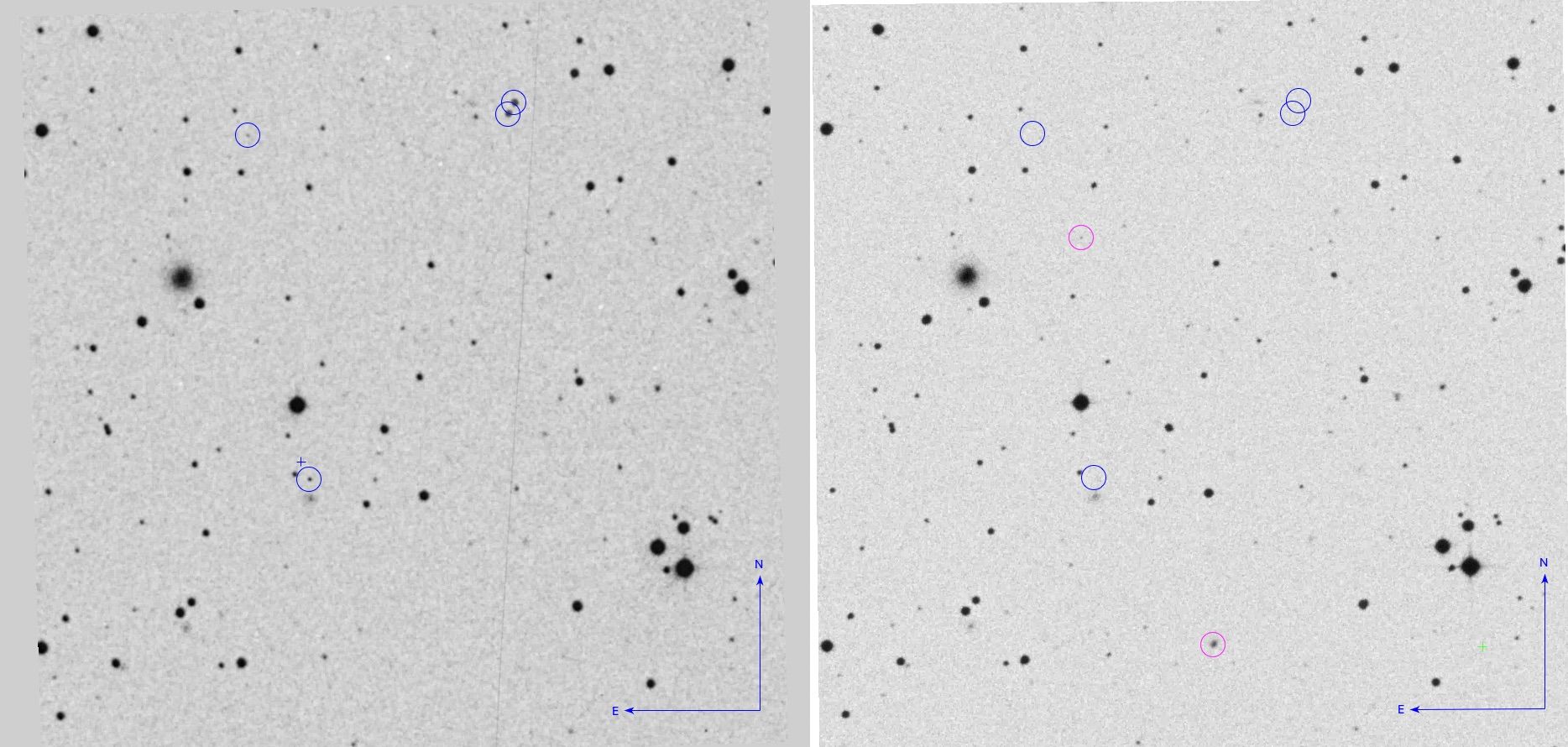
The candidate in SuperCosmos scans of POSS-I red (left) and POSS-II red (right) images (inverted). Transients are marked with blue circles. The candidate with a measured coordinate is marked with a cross (+). Pink circles show defects. Also the grey line crossing the POSS-I field is a scanning defect. Four transients are visible in the POSS-I image, where three follow a straight line.
This is no longer a small swarm of satellites, or their debris. The scale of the observations implies a full-on armada! And this was only the start of it. Villarroel and her colleague Stephen Bruehl, who is an anesthesiologist at Vanderbilt University Medical Center in Nashville and a ufologist, make some even more startling claims. They find a correlation between the dates of nuclear weapons tests and the appearance of these transients during the following 24 hours. They also claim a correlation between the appearance of the transients and UFO sightings in Earth’s atmosphere.
Their entire dataset spans 2,718 days, beginning in 1949 and running up to 1956. Transients are seen in the Palomar plates on 309 of those days (of course, they could have been in the sky on each of those 2,718 days, but not always in the telescopes’s field of view) and there were 124 atmospheric nuclear weapons tests in that same time period.
“Based on joint probabilities, we would expect 14 transients to occur by chance alone one day after a nuclear test,” says Bruehl. “The number of such transients actually observed one day after a nuclear test was 23, which is 64 per cent more than expected by chance. There was only a 1 in 100 chance that this association occurred by chance.”
Bruehl and Villarroel also report an 8.5 per cent increase in probability that a transient would be seen for each reported UFO sighting. “There is less than a 1 in 1,000 chance that this finding was due to chance,” adds Bruehl.
Shadow Deficit
What’s more, on average the number of anomalous transients drops by a third in Earth’s shadow. This is key, say Bruehl and Villarroel. They argue that this could only be explained by objects in high Earth orbit, geosynchronous perhaps. Objects in low orbit only catch the sunlight at specific times, for a few hours after sunset and before sunrise. Objects in higher orbits spend more time during the night in sunlight, and would in theory have been illuminated at the times the Palomar plates were exposed.
“One third of these objects vanish in the Earth’s shadow, and that’s the interesting number,” says Villarroel. “What this means is that a third of the transients can be attributed to reflective objects in orbit. The remaining two-thirds could be anything, including boring explanations like star-like plate defects.”
In their paper, published in Scientific Reports, Villarroel and Bruehl suggest that there are only two possible explanations. One is that there are some kind of unknown atmospheric phenomenon triggered by nuclear weapons tests, but deem this to be unlikely. There’s also no way to test it (thankfully) because of the Partial Test Ban Treaty. Their other explanation is that these really are alien probes curious about humanity’s nuclear ambitions.
For Villarroel, there’s no doubt. “No natural or instrumental explanation proposed so far accounts for all seven properties simultaneously,” she declares. “The only hypothesis currently consistent with the full set of observations are artificial objects in high-altitude orbits prior to Sputnik.”
In SETI there is an unspoken rule, which is that when faced with a seemingly artificial phenomenon, the alien hypothesis must only be considered seriously once all other explanations have been exhausted. The question we now need to ask ourselves about the Palomar lights is, have all the other possible explanations been sought out and fully considered?
The “Boring” Explanation
Unsurprisingly, there are scientists who are dubious that no stone has been left unturned in the search for answers by the VASCO team.
Among the skeptics is astronomer Nigel Hambly of the University of Edinburgh, who specializes in the production of all-sky astronomical surveys and in the archiving of the data that such surveys produce. In particular, during the late 1990s and early 2000s he led the SuperCOSMOS project that digitized photographic plates from two Schmidt telescope surveys – the UK Schmidt Telescope in Australia covering the Southern Hemisphere in the 1970s, and the various Palomar Observatory Sky Survey plates of the Northern Hemisphere from the Samuel Oschin Telescope. It was on the plates from the first Palomar Observatory Sky Survey (POSS-I) that Villarroel and her VASCO team found the anomalous transients.
Hambly has looked at the claims from the VASCO team, and has a definite opinion that these apparent transients have a more down-to-Earth (what Villarroel described earlier in the article as “boring”) explanation, specifically that they are defects in the emulsion on the plates.
To appreciate why this may be the case, we first need to understand how these plates were made and copied prior to digitization.
“At Edinburgh, we have glass copies of the 1950s Palomar plates,” Hambly says. “So for SuperCOSMOS we didn’t scan the originals, we scanned glass copies, and that’s actually very relevant to this issue.”
The original plates were thin, 355mm square sheets of glass coated in Kodak emulsion. They were placed into a plate holder on the telescope and exposed for about 50–60 minutes. Each exposed plate was then taken away to be developed and fixed, producing a negative image with black stars on white space.
Copies then had to be made to be shared with astronomers around the world.
“They would take another plate with a similar emulsion coating on it and make a contact print,” says Hambly. This contact print was a positive rather than negative image, and from that positive copy a whole slew of further copies could be made, producing what Hambly describes as second-generation negatives of the original.
“It’s a two-stage photographic copying process, and those stages are susceptible to contamination,” Hambly continues. “One type of contamination is holes in the emulsion coating of the plate that you’ve used as the positive.”
When the positive copy is exposed to make the second-generation negatives, these holes look like pinpricks of light, since they let light through when exposed. At first glance they might look like stars, but closer inspection can reveal the truth.
“When the VASCO team published their original paper in 2021, I was very interested,” says Hambly. “But I wanted to take a closer look, so I analyzed the profiles of these candidate transients and I noted that they are sharper than the average stellar point source.”
Because of the huge distances involved, stars appear as point sources.
However, on a photographic plate there’s always a degree of messiness, for want of a better word, in the images of stars. That’s because of a number of factors, ranging from errors in telescope tracking to the wind shaking the telescope and the blurring effect of the atmosphere.
“The profiles of the transients are too ‘pointy’ to be above atmosphere photo-detections, unless they are very fast, bright flashes – we’re talking a tenth of a second,” says Hambly.
For Villarroel, this strengthens her argument. “There are already several published studies by other groups demonstrating sub-second flashes caused by solar reflections from artificial objects in geosynchronous orbit,” she counters.
So how can we differentiate between emulsion holes and very short flashes from sunlight glinting off metallic objects in geosynchronous orbit? Villarroel’s trump card, she argues, is the deficit of transients seen in Earth’s shadow. If the apparent transients are all emulsion holes, then they should be fairly evenly distributed across the plates, including in locations that would be in Earth’s shadow. Instead, we see that puzzling one-third deficit.
“I don’t have an explanation for that,” admits Hambly. “Though I do think it’s very difficult to assess the statistical significance of a correlation like that if the sample is dominated by spurious contamination.”
Correlation But Not Causation?
Putting the shadow deficit to one side for a moment, let’s consider some of the other evidence. In a second paper, presented in Publications of the Astronomical Society of the Pacific, the VASCO team connect the appearance of apparently aligned, multiple transients with the Washington D.C. UFO flap of the summer of 1952.
The alignment of the multiple transients often follows a pattern, with two close to each other, and one or more others much farther away. Hambly is skeptical of this too.
“If you’ve got some random distribution and just by chance you happen to have two very close, you’re often going to be able to line another up at a significant distance farther away,” he says, though he admits that this is a qualitative criticism and notes that a quantitative analysis, like the one the VASCO team do in their paper, is difficult to do with the data available.
But underlying this second paper is a reiteration of the correlation between the appearance of the transients and UFO sightings on Earth, in this case the famous Washington D.C. UFO flap, with a series of UFO sightings and radar detections over the back end of July 1952, focused on the two consecutive weekends of 19–20 and 26–27 July. The official explanation was that these sightings were triggered by atmospheric conditions.
This is the problem with the perceived correlation between the transients and UFO sightings – it only exists if you believe the UFO reports in the first place. Certainly, the evidence for UFOs is unconvincing to many, and the vast majority of cases investigated by Project Blue Book found them to be misidentifications of human aircraft, astronomical objects or atmospheric conditions. And while Bruehl points out that ten per cent of UFO sightings examined by Project Blue Book remained unexplained, that doesn’t mean they couldn’t be explained and it doesn’t mean that they were alien spacecraft. It’s difficult to assess statistical significance if you have real doubts about the data, whether that be the UFO sightings or the reality of the transients.
At least for the correlation with nuclear tests, we know those tests took place, and the correlation is a much stronger one than with UFO sightings. Perhaps the atmospheric phenomena explanation shouldn’t be discounted quite so quickly.
Even if, for the sake of argument, we accept that it is possible that alien probes could be visiting Earth, the correlation with nuclear tests does lead to some stretched logic. For one thing, if the transients appear within 24 hours of a nuclear test, then that means they can’t be in orbit all the time, otherwise they would be seen on the plates all the time and there’d be no special correlation.
Bruehl says it as he sees it. “If we assume these are active probes, our results imply they do not always stay in orbit, but that they arrive in orbit shortly after a nuclear test and then leave.”
But does this make sense? Why expend energy coming and going from farther afar (where exactly isn’t hinted at, but it must be within 24 hours’ travel time) when it would make more sense just to stay in geosynchronous orbit over a test site rather than having to keep returning.
Support Supercluster
Your support makes the Astronaut Database and Launch Tracker possible, and keeps all Supercluster content free.
SupportBy the 1950s the splitting of the atom and its use in creating weapons of mass destruction had changed the world, and with the onset of the Cold War, there was a lot of interest, paranoia and even hysteria connected with nuclear weapons. It’s perhaps not surprising that there were many UFO sightings above nuclear facilities and in the aftermath of nuclear tests. It even seeped into popular culture, with classic films such as 1951’s The Day the Earth Stood Still featuring Michael Rennie’s alien visitor Klaatu and his deadly robot companion Gort warning humanity about the dangers of nuclear weapons, while aliens and flying saucers often stood in for the ‘Communist enemy’ in 1950s science-fiction B-movies.
In reality, though, why would aliens be interested in our nuclear weapons? If they’ve really travelled to Earth from somewhere else in the galaxy, they must have access to technology and energy far in advance of even our most powerful nuclear weapons. Their fascination with our nukes would be like scientists traveling back in time and being fascinated every time they see a caveman using fire.
The Holy Grail of the Original Plates
Much of this discussion has been pure speculation, and there’s a danger it could run away with itself. To look at these transients objectively, it’s important to disentangle the observational data from the speculation. The data is the data, regardless of what we think it might or might not mean.
There are several ways that must now be taken to move forward. One is to look at other photographic plates taken at other observatories in the 1950s to see if they show the transients.
“Our next step will be to examine other historical plate collections, especially the European archives, to see whether similar transients appear there as well. If we find matching events in independent observatories, it would be a crucial piece of evidence showing that these phenomena are not local phenomena,” says Villarroel.
Certainly, modern surveys such as the Sloan Digital Sky Survey have failed to recover the thousands upon thousands transients that the VASCO team’s analysis implies, nor have the transients ever turned up on radar.
Other teams also need to now perform their own statistical analysis of the data, to see if they reach the same conclusions regarding the shadow deficit and the correlations with UFOs and nuclear tests. To their credit, Villarroel and Bruehl are making their data available to researchers who wish to take this route.
There’s one big way in which this issue could potentially be solved though, says Hambly, and that’s to go back to the original Palomar plates. Not the copies, but the real thing.
“For me, all bets are off until you return to the original plates and at least verify that what is being analyzed really does look like a good, solid photo-detection on the original plate, but the VASCO team seem to be ignoring this fundamental point,” says Hambly.
The question is, do the original plates still exist? Hambly says that they do, and he also has a line on where they are.
“They are actually still at Palomar Observatory,” he reveals. “They’re not particularly easily accessible, and I don’t know what condition they are in, but I know where they are and I know somebody who has access to them, and I’m following that up since as far as I know nobody in the VASCO team is doing so.”
If the transients really are emulsion holes on the copies, then they would not appear on the originals. Hambly actually thinks some of the transients will still be on the originals, partly because some will be real astrophysical transients, while others could be different forms of contamination. “None of these plates were made in particularly clean conditions,” he says. “People did the best they could but there would always be a little bit of dust contamination.”
Getting to the plates could be the moment of truth.
The hope is that whether the transients are real of just contamination will become clearer upon inspecting the original plates. If the transients do look real as Villarroel, Bruehl and the rest of the VASCO team believe, then Hambly says that “there’d be nobody happier than me if they are right, but I suspect they are wrong.”
Even if the transients are real, it does not necessarily mean that they are alien. Further evidence would be required to prove that. It’s become a truism by this stage, but extraordinary claims really do require extraordinary evidence. Some might suggest that this is deliberately holding the VASCO team’s claims to a higher standard of evidence than ordinary astronomical discoveries, but we’re not talking about someone discovering something mundane like an asteroid or a comet. The possibility of extraterrestrial probes is extraordinary, and like the discovery of gravitational waves or dark energy or other transformative discoveries in the past, the claim that these transients are extraterrestrial probes has to be accompanied by utterly convincing evidence for people to believe it.
If the transients can be unequivocally shown to be real then it is a first step towards that, but history has shown us that until everything else can be ruled out, aliens should always be the last resort.