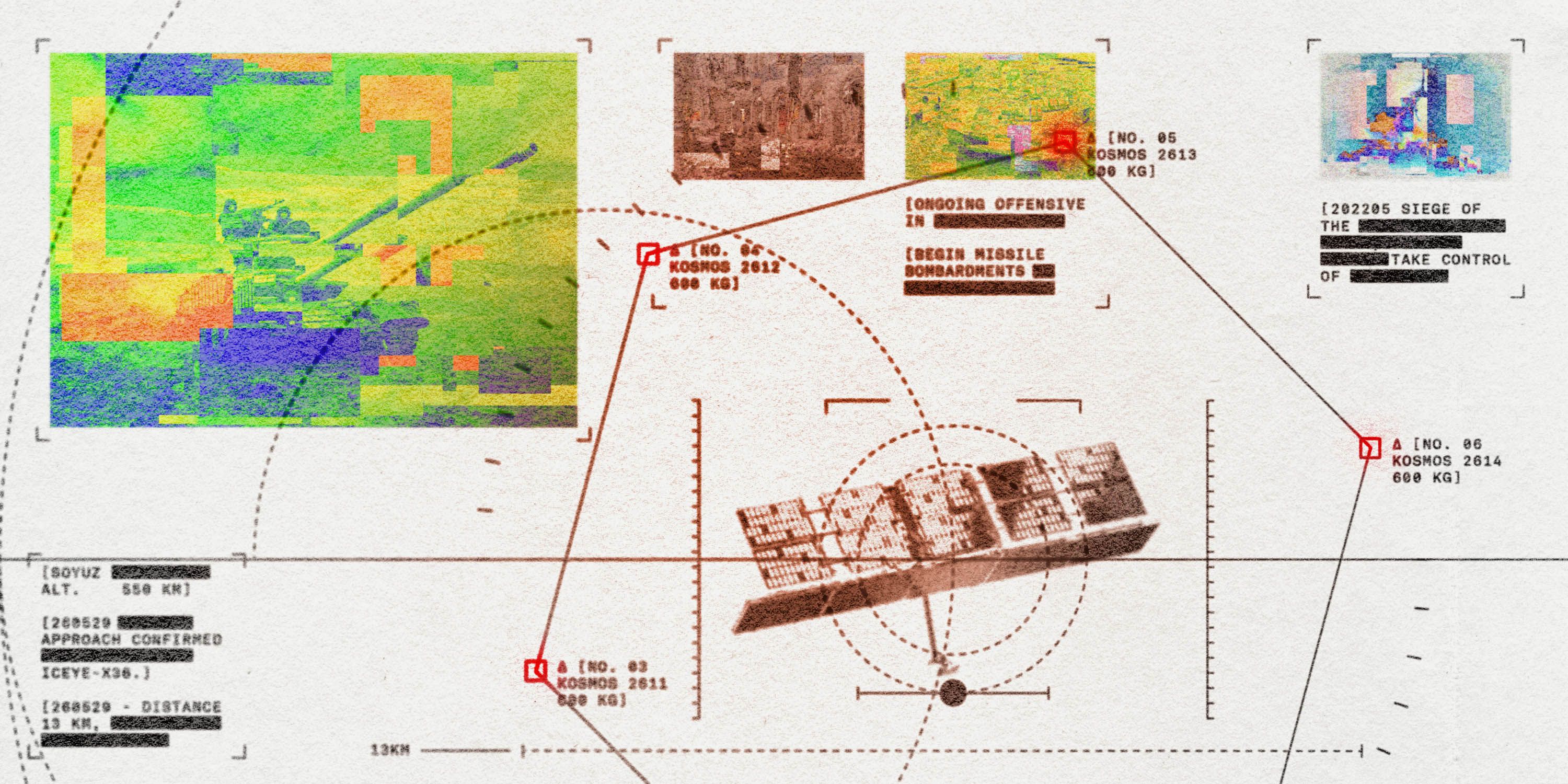
Six mysterious Russian satellites launched earlier this year have been creeping toward an observation spacecraft used by Ukraine.
Experts worry the complex maneuvers may be a prelude to an attempt to destroy the satellite or disrupt its operations.
Something about the way in which Russia placed into orbit a batch of its Kosmos satellites in late April of this year piqued Greg Gillinger’s interest. Gillinger, the Senior Vice President at space intelligence company Integrity ISR, thought it was strange when Russia used its Soyuz rocket to drop off the first of the satellites at an altitude of 550 kilometers, then dispatched the rest to a different orbital plane using the Volga space tug.
The satellites, numbered 2609 to 2614, weigh about 600 kilograms each. But that’s about as much as Western analysts know about them. For Gillinger, the effort Russia put into fine-tuning its orbits raises alarms.
The orbital plane is an imaginary disc tilted toward Earth’s equator, on which a satellite orbits. Changing orbital planes, once in space, is difficult and demands a lot of fuel, Gillinger said. The availability of fuel limits the useful lifetime of a satellite. Most operators perform fuel-hungry maneuvers with caution. Launching satellites with the intention to perform such maneuvers requires big fuel tanks, which reduce the usable payload mass a rocket can send into space.
Gillinger, who previously served as the chief of Intelligence, Surveillance, and Reconnaissance (ISR) at the Combined Space Operations Center of the U.S. Air Force, said that monitoring space launches is simply something he is in the habit of doing. In the weeks following the April Kosmos launch, he kept a close eye on data tracking the six satellites. This data was made available by the U.S. military.
It didn’t take long to confirm that the satellites had an unusual mission.
The original orbital plane the satellites were placed into was already very close to that of two satellites of the Finnish Earth-observing constellation ICEYE. By mid-May, several of the Kosmos satellites were firing their thrusters, burning precious fuel, to align even more closely with the ICEYE duo.
“My assumption is that you don’t do this by accident,” said Gillinger. “It requires an enormous amount of energy to change orbital inclination. It’s not typical to see reconnaissance satellites or communication satellites or other types of satellites do anything like this.”
As they circle Earth, the Kosmos satellites now, thanks to this orbital alignment, regularly pass the ICEYE X36 satellite at a distance that causes concerns. On May 29th, Gillinger said, the distance between the Kosmos 2614 and ICEYE X36 shrank to only 13 kilometers.
Gillinger says that although the Russian sextet doesn’t “do anything dangerous or alarming” at the moment. The close approaches suggest that Russia may want to cause some harm to the ICEYE satellites or disrupt their operations.
“It’s a behavior we haven’t seen before,” Gillinger said. “It could be something as easy as an inspection mission. We don’t know. They might even want to interfere with the ICEYE satellite kinetically or non-kinetically.”
Kinetic interference refers to the use of physical force to destroy a target. In the space context, a kinetic attack could involve an intentional collision or the use of robotic grabbers to knock out a satellite. Non-kinetic interference could involve signal jamming or blinding the satellite’s sensors with laser light.
That Russia should be interested in ICEYE comes as no surprise to experts. The Finnish constellation is the world’s largest fitted with synthetic aperture radar instruments (SAR), which observe Earth’s surface through clouds and in the dark. Since the beginning of the war in Ukraine, ICEYE has been a key supporter of the Ukrainian defense effort. The embattled country even purchased priority access to the constellation’s images using money collected in a crowdfunding campaign.
“You have some curious in-orbit developments that aren’t normal, paired with a satellite that has been actively supporting Ukraine for years,” remarked Gillinger.
In fact, Russian officials have previously publicly expressed their discontent with Western satellite operators aiding Ukraine. In October 2022, about eight months after the invasion, Konstantin Vorontsov, the deputy director of the Russian foreign ministry’s department for non-proliferation and arms control, told the United Nations assembly that such “quasi-civilian infrastructure may become a legitimate target for retaliation.” He also described the role of commercial satellites in the defense effort as “an extremely dangerous trend.”
ICEYE declined to comment on the situation.
Space situational awareness software company COMSPOC confirmed its experts, too, had observed the close approach between Kosmos 2614 and ICEYE-X36 on May 29. Although they estimated the distance of the closest approach at 43 kilometers.
“What makes this maneuver particularly noteworthy is that the deployment pattern and subsequent orbit plane changes are highly unusual,” a COMSPOC spokesperson told Supercluster in an email.
The company said it would continue observing the situation.
Victoria Samson, the Chief Director for Space Security and Stability at the Secure World Foundation, said that although the Kosmos satellites are not the first Russian spacecraft to sneak up on Western spacecraft in orbit, the incident is a step-up from earlier Russian threats.
“This type of RPO (rendezvous and proximity operations) is not unusual for Russia,” Samson told Supercluster in an email. “Their Luch and Luch 2 satellites have gotten co-planar [orbiting in the same plane] with numerous US intelligence satellites. But this is the first time, as far as I know, that Russian satellites have gotten co-planar with a commercial satellite in low Earth orbit.”
Samson is a co-author of the Secure World Foundation’s Global Counterspace Capabilities Report published in June 2025. The report revealed that although Russia’s civilian space program may have been in decline for years, the Eastern European power’s military space technology is very much on par with that of China and, in many aspects, exceeds the capabilities possessed by the United States and Europe.
In fact, Russia’s maneuvers in orbit have been causing a stir among Western space security experts for more than a decade. The Luch satellite, mentioned by Samson, has been zooming around the geostationary ring — the orbital region at the altitude of 36,000 kilometers, where many telecommunications and spy satellites reside — since 2014. During those years, Luch has repeatedly positioned itself close to various Western spacecraft. Its sibling satellite, Luch 2, has been performing similar maneuvers since 2023.
European authorities think the Luchs may have been eavesdropping on European commercial and state-owned communications satellites and might even be trying to disrupt their transmissions using on-board jammers.
Before Kosmos 2609 to 2614, other satellites from the Kosmos family have conducted suspicious exercises in low Earth orbit. In addition to the ICEYE SAR constellation, the low Earth orbit, at altitudes of up to 2,000 kilometers, is home to internet-beaming mega-constellations such as SpaceX’s Starlink and other Earth-observing fleets capable of imaging Earth’s surface in detail. Many of these systems have been aiding Ukraine’s defence efforts against Russia.
The maneuvers, performed regularly since 2015, have demonstrated Russia’s ability to approach other satellites in Low Earth orbit, and, in some cases, suggested that Russia possesses technology to enable satellites to fly at a close distance in a coordinated manner.
Russia has been secretive about the purpose of these tests.
The Secure World Foundation states that while these technologies could be used for satellite servicing and inspection, they could also enable Russia to either disrupt Western satellite services by jamming their signal at close distance or even cause physical damage.
Gillinger said the ICEYE incident sends a signal to Western commercial satellite operators and governments to rethink their approach to space situational awareness. Simply monitoring objects in space using telescopes and radars on Earth may no longer suffice.
Support Supercluster
Your support makes the Astronaut Database and Launch Tracker possible, and keeps all Supercluster content free.
Support“We might want to start thinking about equipping satellites with their own space awareness capabilities,” he said. “If you really want to be certain what’s going on around your satellites, having an onboard capability to see the surrounding area will become more important. If the ICEYE X36 satellite had a small space awareness sensor suite on board, the operators would be able to observe the Kosmos satellite and determine whether they should be maneuvering."
Space security experts have been sounding the alarm for years about emerging threats in the space environment. Last year, China sent ripples through the space world by performing close-proximity maneuvers described as satellite dogfighting. U.S. military sources said at that time that five Chinese satellites had been moving around each other “in synchronicity and with control” in a way reminiscent of the acrobatic chases performed during the Second World War between German and British fighter aircraft.
In January this year, Germany’s State Secretary for Defence Jens Plötner said that European satellites experience interference from Russia and China “on an almost daily basis,” according to Euronews.
Space security researchers are warning about the susceptibility of space technology to cyber attacks. The space around Earth is full of older satellites built without cyber protections, and although no satellite hack has been verifiably reported to date, researchers have discovered multiple vulnerabilities in widely used onboard software.
The invasion of Ukraine in February 2022 was preceded by a cyber attack on terminals of American satellite operator Viasat, which was at that time frequently used by Ukrainian forces.