Every time a new satellite is launched, we’re adding another duck to the shooting gallery above the Earth.
Space is not empty. Low-Earth orbit (LEO) is filled with space junk, lethal little chunks of debris that could blow a hole in a satellite, but space junk is a problem of our own making and one that we can fix if we put our minds to it. There are other, potentially even more deadly bullets out there that we can’t do anything about. Tiny micrometeoroids, ranging from millimeters to centimeters in size, constantly rain down on the Earth. For the most part, they are sparse enough not to be a high-risk danger. Periodically, though, Earth runs into dense streams of meteoroids, deposited by the tails of comets or active asteroids. When Earth encounters one of these streams, we are treated to a meteor shower, but for satellites the impact risk goes up.
The comets that lay them return every few decades, resulting in the streams developing denser patches coinciding with the comets’ return. Usually Earth doesn’t receive the full whack from these streams, avoiding these denser patches, but when Earth does encounter one of them, the meteoroid rate can jump up, and when that happens we don’t just experience meteor showers, but meteor storms.
These storms pose a huge natural hazard to satellites, spacecraft and space stations in orbit, and even to future Artemis missions on the surface of the Moon. That’s the conclusion of an award-winning research paper by Brian Murphy and Richard Cannon of the University of Edinburgh, who scooped the B612 Foundation’s Schweickart Prize this summer. The danger from meteor storms has been drastically understated, say Murphy and Cannon, and as we head towards a new storm season, the risk of catastrophic damage in orbit, possibly leading to a cataclysmic Kessler syndrome event, has never been higher.
Storm Warning
The B612 Foundation is a non-profit organization founded in 2002 to work towards being able to deflect hazardous asteroids away from Earth. Among its co-founders is the Apollo 9 astronaut Rusty Schweickart, who gives his name to the foundation’s annual prize. Much of the foundation’s early focus was on the 325-meter-wide asteroid Apophis, which at the time had a small chance of hitting Earth in 2036. We now know that Apophis will not impact, but it will pass closer to Earth than geosynchronous satellites in 2029 and be visible to the naked eye.
Not all dangerous objects from space are large ‘city killers.’
While most meteoroid streams are fairly harmless, Murphy and Cannon’s research highlights how a handful of streams should have us very worried.
“We know of about a thousand different meteoroid streams in the Solar System at present, and these streams come from comets and asteroids that are constantly ejecting material along their orbit,” Murphy, a planetary scientist who has just completed his PhD at Edinburgh, tells Supercluster. “These streams are everywhere, but there’s six to twelve that are more hazardous.”
Consider that in a normal year the two most prolific meteor showers, August’s Perseids and December’s Geminids, might experience rates of 60 to 100 meteors per hour at their peak. In the early 1990s, after encountering a denser-than-normal patch of meteoroids left by comet 109P/Swift–Tuttle, Perseid meteor rates jumped up to more than 200 per hour. Comet 55P/Tempel–Tuttle, which is the progenitor of the Leonids meteor shower, can leave even denser patches of dust in its wake. Every 33 years we run into these patches, which trigger meteor storms, and the last time this happened we experienced storms for three successive years starting in 1998 with rates up to 3,000 meteors per hour. Observers reported stepping outside, looking up, and seeing meteor after meteor gracing the night sky. Remarkably, the storms of 1998–2001 were relatively subdued; in 1966, the Leonids stormed so hard that the rate was 144,000 meteors per hour at its peak — that’s more than 40 meteors each second.
There were relatively few satellites in the sky during these storms, but still, there was a casualty: in 1993 the European Space Agency’s $1.2 billion Olympus-1 communications satellite was hit by Perseid meteors during the shower’s most recent storm and was damaged beyond any hope of repair.
Shooting Gallery
There have been no meteor storms since the Leonids in 2002, but they are about to return with a vengeance.
“Between 2028–2034 we’ll be approaching the dense packets in the streams again,” says Murphy.
These include a dense patch in the Perseid stream that is a dust filament laid down by 109P/Swift–Tuttle all the way back in 1479, and which Earth will re-encounter in 2028. Following this, Earth will then pass through dense patches in the Leonid stream in 2033 and 2034. Powerful storms are expected and this time they will have a lot more ducks to shoot at.
As of July 2026, there are more than 16,000 active satellites orbiting Earth with plans to add over 2.2 million more over the coming decade, ranging from a million-strong mega-constellation of data centers to giant mirrors spilling light pollution onto the ground. Back in the 1990s, the total cross-sectional area of all the satellites and spacecraft in orbit was 0.03 square kilometers. That didn’t really give meteoroids much to aim at, and they still managed to take out Olympus-1. Currently, the total cross-sectional area of all orbiting assets is 0.36 square kilometers, which is still fairly modest.
Fast forward a decade and the total cross-sectional area of SpaceX’s planned orbiting data centre alone, where each of the AI1 satellites armed with giant solar arrays will have dimensions of approximately 70 by 20 meters, will be greater than 1,000 square kilometers.
It’s not going to be possible for satellites to get out of the way when a meteoroid storm hits; they will be the very definition of sitting ducks. There are ways to protect satellites, however.
What Can We Do?
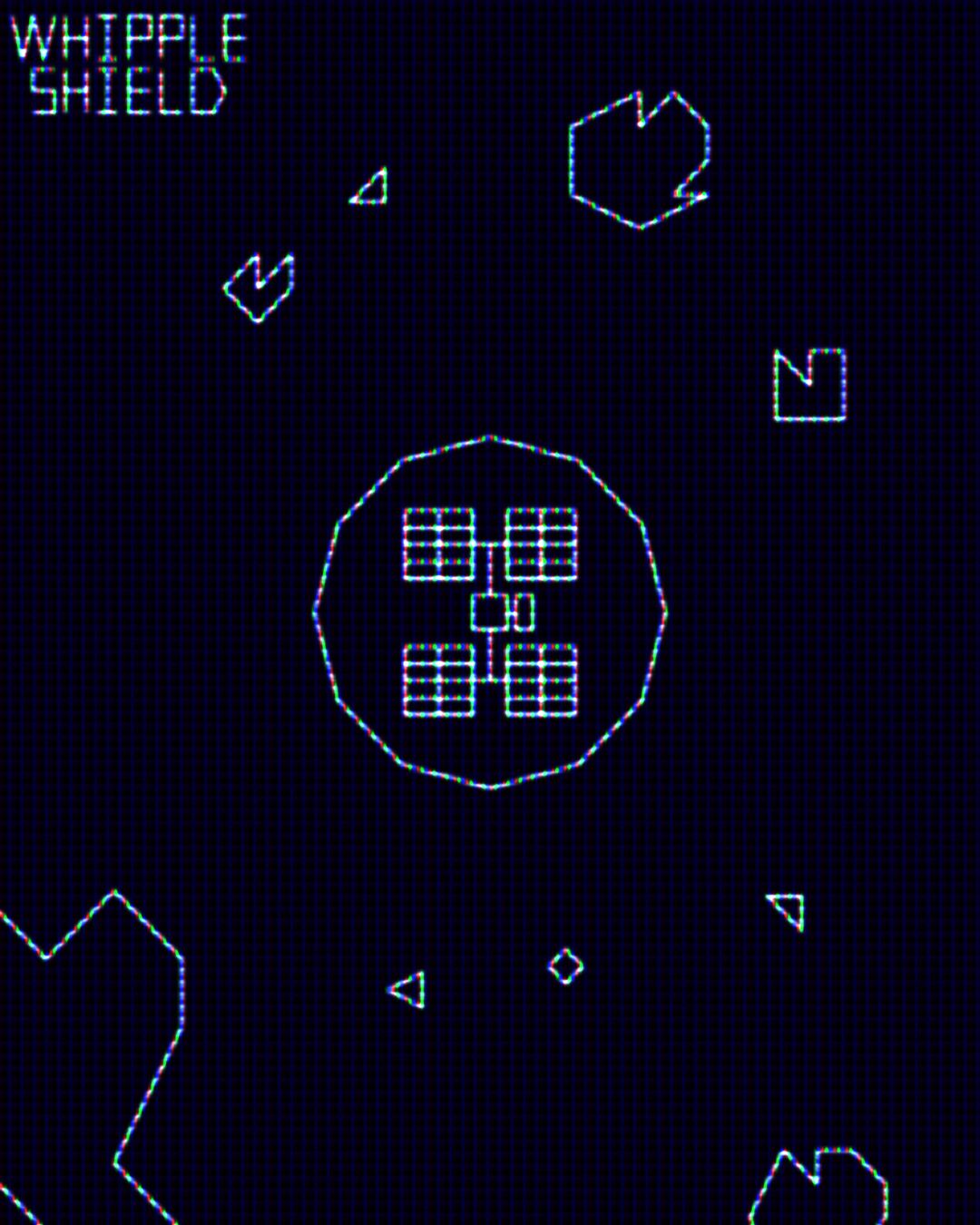
Number one is arming satellites, spacecraft and space stations with something called a ‘Whipple shield’, named after the astronomer Fred Whipple, who coincidentally is synonymous with cometary studies having developed the ‘dirty snowball’ model describing the compositions of comets. A Whipple shield features a thin outer layer that is designed to absorb the energy of any small impactors and even break them apart before they hit the spacecraft hull. Whipple shields are already in widespread use on the International Space Station and if deployed as standard on satellites they could be used to protect critical systems.
Another way to protect satellites is to turn themselves edge-on to the incoming meteoroid stream, thereby reducing their cross-sectional area. This would be particularly important for satellites with large, thin solar arrays, such as those aforementioned SpaceX AI1 satellites. Although the International Space Station has proven that solar arrays can take a lot of damage without loss of function, every impact chips away at the solar arrays, sending tiny flakes of debris spinning away into space that can potentially hit another satellite like a bullet. That secondary impact then produces more debris, and so on and so forth in a cascading demolition derby of destruction. We call it Kessler syndrome, and at its worst it could gradually destroy everything in low-Earth orbit, leaving nothing but a swarm of battered and smashed satellites and millions of pieces of debris. With solar arrays taking up so much area, they are the most likely parts of a satellite, spacecraft, or space station to be hit by a meteoroid, and the most likely to produce debris.
“That’s what we’re really worried about with the solar arrays,” says Murphy. “But there’s not much we can do besides re-orientating the satellites and making their operators aware.”
Are the operators listening?
Murphy says that it is early days, with a lot of complex discussions still lying ahead.
He envisages a two-fold plan of attack to make people take the threat of meteoroid streams seriously. First is to obtain international consensus through the United Nations, and this will require the formation of one and perhaps two new bodies.
Support Supercluster
Your support makes the Astronaut Database and Launch Tracker possible, and keeps all Supercluster content free.
SupportThe first would be an independent group of experts — Murphy proposes calling this group the International Commission on Space Infrastructure Resilience, or ICSIR for short. ICSIR would produce reports upon which they would base their recommendations to the United Nations Committee on the Peaceful Uses of Outer Space. From here it falls under the purview of the United Nations to create another sub-group that Murphy suggests could be named WARDEN, or Warning-network for Asset Resilience from Dusts, Ejecta and NEOs (Near-Earth Objects). WARDEN would coordinate all planetary defense activity, extending beyond Earth orbit to encapsulate the whole Earth–Moon system to produce global mandates designed to help organize the protection of off-world systems that are currently under-protected.
Insurance Against Catastrophe
While the United Nations very visibly fosters good intentions for international collaboration, “when it comes to actually mandating binding contracts at the international level, I think history speaks for itself,” says Murphy. So he is approaching the problem from the other end too, and engaging the satellite operators and space agencies directly.
To this end Murphy has founded Oroff, a planetary defense company based in Maryland. As well as designing a space mission called Loki that aims to orbit a small asteroid and use the spacecraft’s own gravity (a technique known as a gravity tractor) to divert the asteroid away from a collision course, Oroff is engaging directly with those who work in the space industry to alert them to the risk from meteoroid storms. In particular, on the recommendation of the B612 Foundation’s Ed Lu, Murphy is reaching out to the satellite insurers. He figures that if insurers are aware of the risk from meteoroid storms, they’ll factor that into the price of their insurance, thereby making the spacecraft operators aware of the need to reduce risk to reduce cost.
“We’ll work with spacecraft insurers to buy down that risk, and the insurers will then work with the operators,” says Murphy. “There is a relatively well-understood hierarchy between the insurers, the underwriters and the operators. The one issue with these large mega-constellations is that they are increasingly becoming self-underwritten and self-insured, so we might have to work with the operators directly there, which might create a larger headache, but ultimately I think companies will want to be self-preserving.”
While we might imagine that companies and their investors would want to protect their billion-dollar assets, there is always the worry that some will cut corners to save money or protect profits. All it takes is one bad actor to neglect their responsibilities and we could end up with full-blown Kessler syndrome above our heads.
This is where the real test will be — can rules designed to protect orbital space be enforced successfully?
“If you have a handful of nations monopolizing orbital space that ultimately belongs to all humanity and all life on Earth, one actor behaving badly could jeopardize all of that,” says Murphy. “Then how will the rest of the world react?”
It’s the tragedy of the commons writ large in Earth orbit.
This describes how a shared resource inevitably becomes over-exploited or irresponsibly managed by one or two parties, resulting in that shared resource becoming ruined. What could be especially tragic is that there is some vital infrastructure in space that is crucial to modern society: Earth-observation satellites essential for monitoring climate change, the environment and natural hazards; weather satellites that provide data for our forecasts; communications satellites that enable everything from satellite TV, telephony, high-speed global banking and the global internet (although many of these satellites are also in much higher geosynchronous orbits); military assets crucial for the defense of nations; plus any space stations we might have in low-Earth orbit at the time. Losing them won’t send us back to the Stone Age, but it would severely hamper many of the functions of modern society, and it would take decades to clear up as we would wait patiently for the debris to re-enter the atmosphere.
Yet these important satellites are making up an increasingly small minority of the satellites in space, most of which are overwhelmingly commercial and unnecessary. It would truly be a tragedy of the commons if we lost our important space infrastructure because of the filling-up of low-Earth orbit to satisfy greed and profits. Consequently, one might come to the conclusion that more effort should be placed on challenging the launch of mega-constellations in the first place, reducing the risk in space before anything even gets off the ground, but that seems a forlorn hope at this present time.
Runaway Destruction
Kessler syndrome would be an environmental catastrophe of the likes never seen before. Each impact would produce debris that would spin away and produce more impacts, cascading at an exponential rate until all of that orbital space — most probably low-Earth orbit where the vast majority of satellites will be located — is filled with debris.
There are already millions of tiny fragments of space junk in the size range of millimeters to centimeters, and they are already causing damage to satellites. It’s enough to prompt some researchers to suggest that Kessler syndrome has already begun, a decades-long process of reducing low-Earth orbit to rubble. Those particles of space junk orbit at about ten kilometers per second, but micrometeoroids come in at velocities between 30 and 70 kilometres per second.
“That’s what makes the Perseid and Leonid meteoroid streams very hazardous because the meteoroids are traveling at 60 and 70 kilometers per second respectively, relative to the Earth,” says Murphy.
The faster the meteoroids travel, the greater the damage they can do.
Whether it has already begun or nor, and whether damage from a meteoroid storm will just exacerbate a disaster that was already happening in slow motion, a runaway Kessler syndrome would, over the course of many years, render low-Earth orbit inaccessible. However, the concerns are qualitative rather quantitative at the moment, though Murphy is looking to remedy that.
“One of the primary things we want to look at with Oroff is the increase in risk of Kessler syndrome from micrometeoroid storms, as well as specific orbits or time periods when that risk becomes almost exponential in regards to different streams and different satellite classes,” says Murphy.
Space is dangerous, and our future in space depends on being able to protect ourselves and our assets from the hazards that lurk in the dark while not taking that space for granted to do with as we please. As we reach out to new frontiers the hazards we will face will increase and it won’t just be meteoroids that threaten spacecraft, but also debris from asteroid-deflection efforts such as NASA’s DART mission, or debris from asteroid or lunar mining projects. We’ve only taken baby steps so far, and if we want to venture any further it is crucial that we learn how to protect ourselves now.