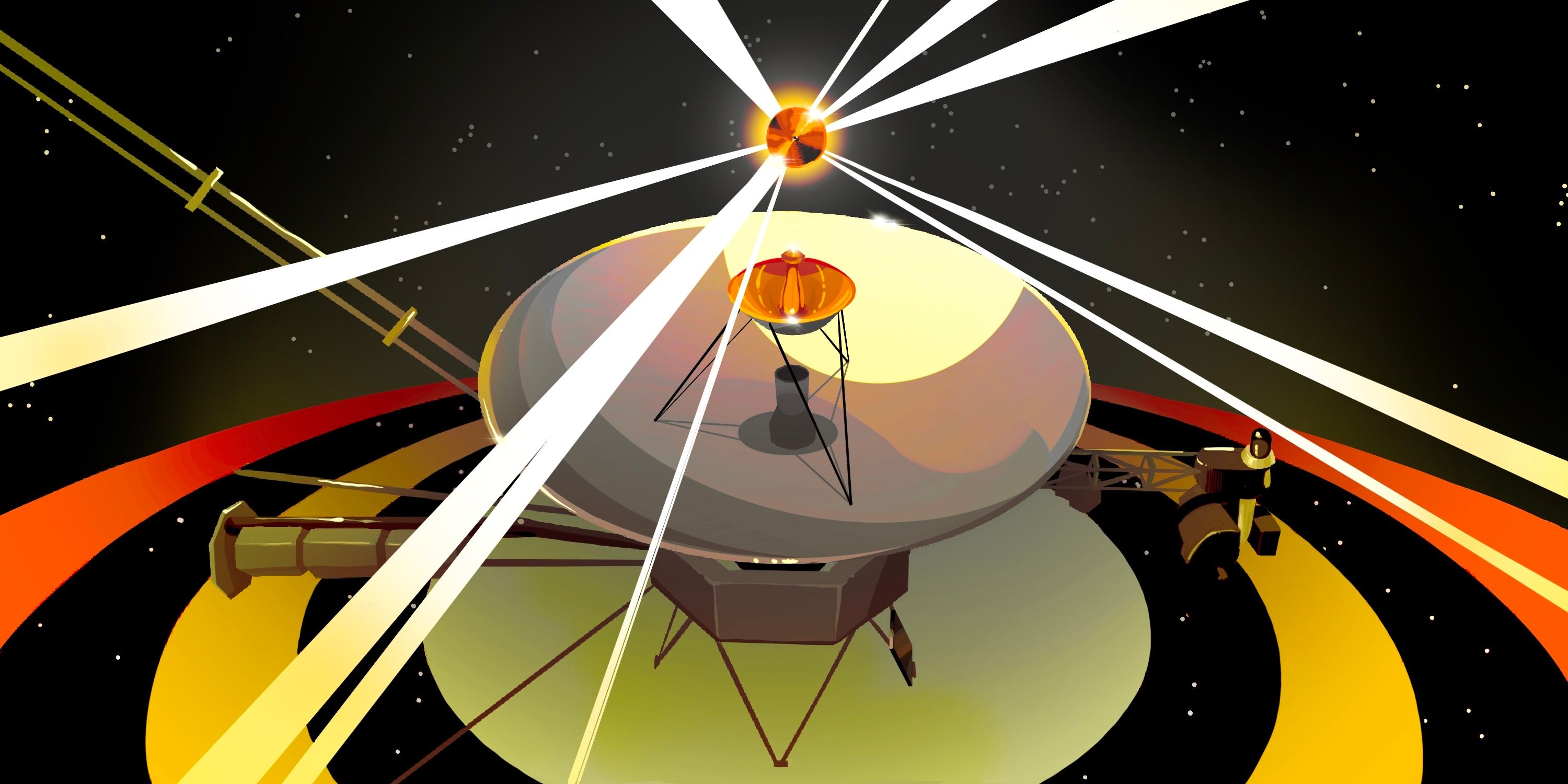
Beyond the bubble of our solar system, two spacecraft continue their march toward the darkness.
Voyager 1 and Voyager 2 are expected to celebrate 50 years of operations next year. From an already ambitious joint mission to catalog the outer planets and moons of the outer solar system, the spacecraft more recently pivoted to charting the reaches of interstellar space.
But that latter effort is becoming more difficult. Any car owner will tell you how quickly critical systems fail even 10 years into operations, and that’s if you’re lucky to make it that far. The twin Voyagers are so old that they are well into “classic car” territory, including their original computer program Fortran — an early IBM language optimized for science operations.
The spacecraft are also so old that the literal infrastructure holding them together, especially power, is really showing its age. Voyager 1 had to shut off yet another science instrument earlier this year after a routine roll in space suddenly (and unexpectedly) reduced its power supplies. Only two of its original 10 instruments are working. Voyager 2, slightly closer to home and in a little better shape, is down to three of its 10 working science instruments.
But both spacecraft are losing 4 watts a year, which is a significant percentage of the 470 watts that they each had upon launch. And while today their story includes age and loss of capabilities, we should take a moment to acknowledge that they continue to do very well. It shows how far the spacecraft have literally and figuratively come — and the hope that engineers just sparked after a unique “Big Bang” power move in deep space, announced this month, revived enough energy from Voyager 2 to keep its three instruments going for, as NASA termed it, “at least an extra year.”
Next up is Voyager 1, in a few months.
—
In 1965, a young graduate student from the California Institute of Technology — Gary Flandro — made the discovery of a lifetime while doing a summer position at NASA’s Jet Propulsion Laboratory near Los Angeles. He found that the outer gas giant planets of our solar system, which run from Jupiter to Neptune, align uniquely every 176 years to allow spacecraft to slingshot from one to the next—and the planets would do so again in the 1980s.
“He said, ‘Wow, we could do swing-bys and get a little energy, little speed bump each time we went by one,” said Alan Cummings, a co-investigator on the Voyager mission, in a 2025 public talk at Caltech, which manages JPL on behalf of NASA. “That caught NASA's attention,” Cummings continued. “And they said, ‘Yeah, okay, we better do it because it's going to be a long time before we can do it again.’”
And so that double-spacecraft mission that eventually became known as Voyager 1 and Voyager 2 was born. Voyager 2 was the first of the two to launch, reaching space on Aug. 20, 1977 — almost exactly 49 years ago today. Voyager 1 followed 16 days later. The first few years brought a flurry of discoveries from Jupiter and Saturn. While both planets had been seen before by spacecraft, the Voyager discoveries collectively included milestones like finding a ring system at Jupiter, spotting a weird orange haze surrounding Saturn’s moon Titan, and discovering several new moons.
After Saturn, the spacecraft separated pathways quite widely. Voyager 1 flew away from the ecliptic of our solar system (which apparently was an orbital sacrifice the team made to observe Titan from up close) while Voyager 2 kept zooming on towards Uranus and Neptune, becoming the first and so far only spacecraft to observe those worlds from nearby. Voyager 1 had its last planetary close encounter in 1980, and Voyager 2 in 1989.
Next came a non-metaphorical battle against the forces of darkness.
Both spacecraft would never be needed for a planetary flyby again, so some instruments for those purposes were shut off to save on power. But the plutonium supply, though mighty, continued to dwindle and the spacecraft continued to get older, necessitating one by one for instruments to wind down. The science with the remaining probes, however, was worth the effort.
Voyager 1 passed the heliopause, or boundary of the solar system, in 2012 and Voyager 2 followed in 2018. But their interstellar mission actually began all the way back in 1989, according to NASA. With planetary flybys all finished, the spacecraft were then used to chart the termination shock — where the solar wind slows down — the heliosheath at the outer edge of the heliosphere, and interstellar space itself.
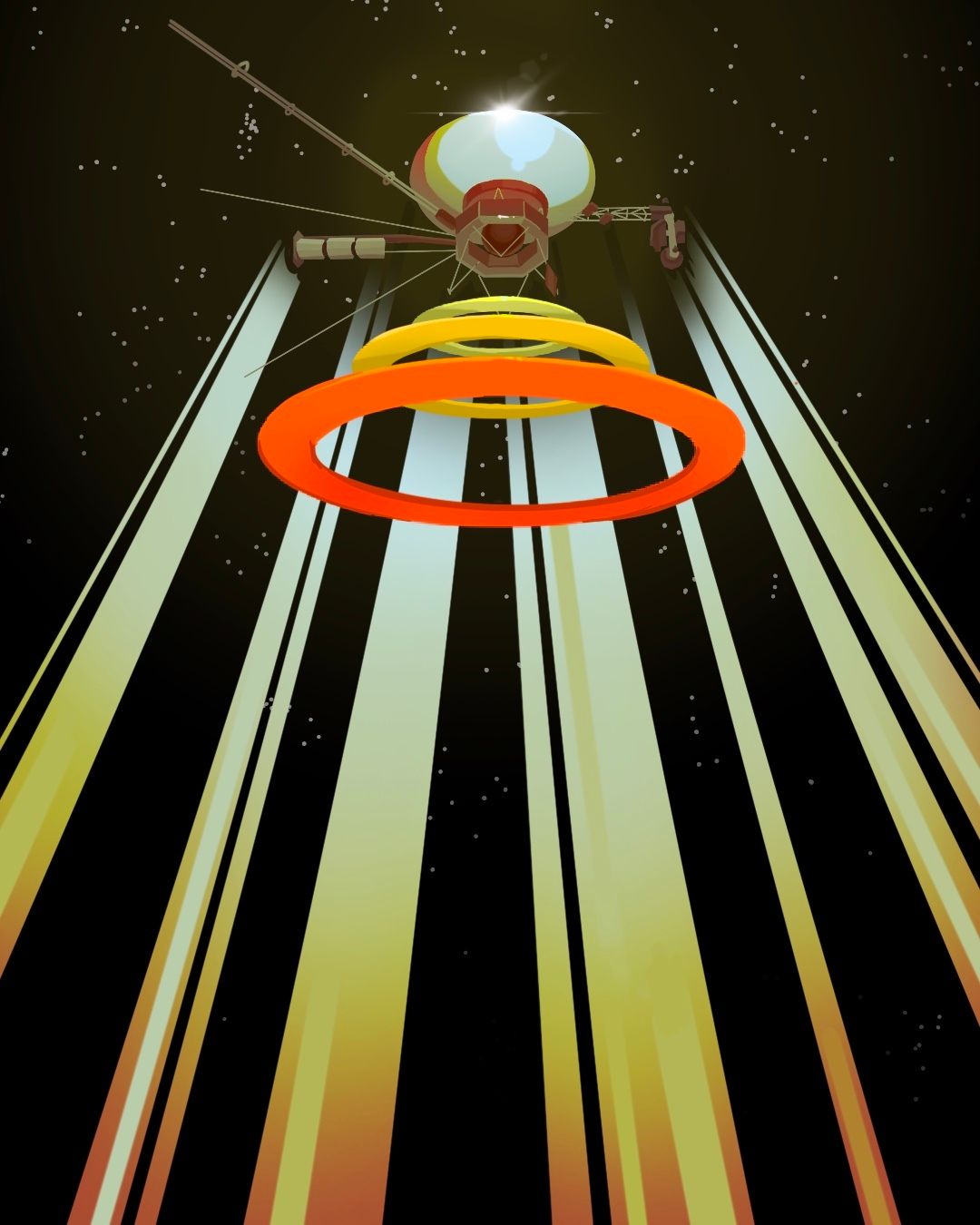
While interstellar regions may appear empty of life, the quiet environment allows us to hear things far away in the universe. Or as Johns Hopkins University Applied Physics Laboratory (APL) once elegantly put it, the interstellar medium is “a vast region of space filled with the dust and gas that gives rise to stars and planets and the cosmic rays that massive stars release in their last, explosive breath.”
In this region, where we can listen to nearby stars, APL is trying to learn “how our solar system interacts with this region, building one of the instruments on Voyager that revealed where the edge of the solar system lies, as well as managing and operating NASA missions to describe the dynamics and interactions of our sun’s protective heliosphere with matter that lies between the stars.” Here, we can not only learn about our own solar system, but other ones that lie beyond — letting us chart the universe in a unique way from Voyager, the two only operational sailors from humanity upon the interstellar ocean.
Voyager 1 briefly fell silent in 2024 after shutting down, all by itself, one of its two radio transmitters (in the X-band) as the spacecraft tried to take action on dwindling power supplies. Engineers luckily linked up with the spacecraft again a few days later, using an S-band transmitter that had not been activated since 1981; the decision was made in part because the S-band uses less power and posed less risk to the spacecraft.
Have we mentioned yet how far these interstellar fixes have taken us? Voyager 1 is almost a literal light-day from Earth, as it will officially reach 24 hours’ one-way radio signal travel time in November. Voyager 2 is also more than 23 hours’ hailing distance away. So even confirming that each spacecraft is able to hear us takes a two-day round journey. Just ask the engineers of the Mars MAVEN spacecraft, which lost contact forever last year after it began unexpectedly tumbling on the far side of the Red Planet from Earth. For perspective, MAVEN was well beyond its design lifetime. Yet the situation illustrates how quickly things can deteriorate even at Mars, where missions take a mere 40 minutes or so at worst to return a signal — and that planet is known for its dangers to many spacecraft, landers and orbiters alike.
Support Supercluster
Your support makes the Astronaut Database and Launch Tracker possible, and keeps all Supercluster content free.
SupportMAVEN returned science for an incredible 11 years. The Voyagers, however, are pushing 50. And learning how to operate the Voyager spacecraft, despite their age and complications, may just help humanity push future older spacecraft a little longer in their lifetimes. There’s hope, even after the Voyagers fall silent, that at least one other sentinel could call soon from such a distance: the New Horizons spacecraft, most famous for showing us Pluto from up close, will enter interstellar space in the 2040s and its team has said it could keep operating until 2050.
But getting to interstellar space is one thing.
Keeping a spacecraft happy and calling home for that long is another. As mentioned earlier, Voyager 1 had another awful moment in February 2026, when a planned roll maneuver caused an unexpected power-level drop. Engineers already knew that the spacecraft was close to the edge and was programmed to use a fault protection system to shut down some components if it fell below certain power levels. Recovering the half-century-old probe was tricky, but it worked — simply put, by sacrificing another instrument.
But that was a short-term fix. The best option was to plan ahead, as always, requiring what NASA called a “Big Bang.” “The idea is to swap out a group of powered devices all at once — hence the nickname — turning some things off and replacing them with lower-power alternatives to keep the spacecraft warm enough to continue gathering science data,” the agency wrote in the Voyager 1 operations update, delivered in April. “The team will implement the Big Bang on Voyager 2 first, which has a little more power to spare and is closer to Earth, making it the safer test subject.”
Testing and careful troubleshooting occurred, with the inevitable wait times factored in. At some point recently, it was determined that Voyager 2 was as ready as it would be, and the “Big Bang” was commanded to happen. The happy news came to us on Aug. 4: “The savings should provide power to keep its three instruments operating for at least an extra year,” NASA wrote in an update, adding, “Without the Big Bang activity, the mission would have had to turn off another instrument on Voyager 2 before the end of 2026.”
Voyager 1’s turn is up next. To be sure, any big changes to the spacecraft’s configuration are in themselves risky, so no one can fully guarantee that anything will work. But NASA is preparing to give the Big Bang the best chance possible for Voyager 1, which will see the maneuver implemented in the coming months. But the payoff is invaluable. Just as with Voyager 2, the expected change on Voyager 1 should allow scientists to be “extending how long the spacecraft can continue to do science,” the agency wrote.
But should the Big Bang succeed, just how far can the spacecraft fly?
Four years ago, Suzanne Dodd, project manager for Voyager at JPL, warned that it’s unclear how long any spacecraft will persist — let alone those of such age. "We don't know how long the mission will continue, but we can be sure that the spacecraft will provide even more scientific surprises as they travel farther away from the Earth," she stated in 2022.
NASA has said in recent months that power margins are “razor-thin”, and Dodd offered more specifics on that: when she was writing her blog post, she said each spacecraft only had five or six watts to spare. And transmitting alone takes a lot of watts: she said 200 (of the spacecraft’s 470) are required to run the transmitter to get signals to our planet.
That said, the manufacturing of the spacecraft and the craftiness of the Voyager team have helped these spacecraft operate quite well, so far away. "If we got really lucky, maybe doing some operating below some thresholds, we might be able to go out to the 2030s," she said. Also in 2022, she said in a different JPL livestream that she was confident each spacecraft would mark its 50th anniversary in space, but she hoped they could persist to a distance of 200 astronomical units — which, if you can believe it, would be 2035.
At least one person on the original science team has expressed wonder that the mission made it this far. Ed Stone, who died in 2024 at age 88, was the first leader of the Voyager project and held that position for decades. In 2017, at a Caltech event, he told an audience that the mission was so successful that “you can’t quite complain.”
“After all, this is a 40-year mission of discovery already,” he noted at the event that celebrated the four-decade mark of the mission, “and we have, maybe, up to 10 years more. And it would have been a great mission with half of that. I'm not going to be sad in that sense at all," he said.
After all, the Voyagers — on top of their incredible scientific legacy — have shown it is possible to keep a spacecraft running for close to two generations, as they are the longest-operating spacecraft by NASA. And there are similar stories of ingenuity on long-running spacecraft out there — and not only famous ones like the still-going International Space Station with some elements still running after 28 years, or NASA astronauts repeatedly servicing the now 36-year-old Hubble Space Telescope, or the Katalyst Space LINK mission trying to connect with the falling, 22-year-old Neil Gehrels Swift Observatory later this summer.
For example, there’s the group who briefly managed to fire thrusters in 2014 on a NASA spacecraft that had been dormant for 27 years. That spacecraft was the International Sun-Earth Explorer-3 / International Cometary Explorer, launched the year after the Voyagers in 1978. After a mission including returning data from Halley’s Comet, NASA shut down the spacecraft in 1997 to prioritize other things.
The “reboot team”, made up of independent scientists, engineers, and programmers, agreed with NASA to try to revive the spacecraft and redirect it for more observing in Earth’s orbit. While the thruster firings ultimately failed, probably due to a lack of nitrogen, it demonstrated that just because a spacecraft is old, you shouldn’t count it out.
We are testing out technology in Earth orbit to service spacecraft here.
Northrop Grumman recently stretched out the robotic arms on its new Mission Robotic Vehicle to service satellites, following success with servicing the INTELSAT 901 spacecraft in the past. There are too many of these “orbital servicing” missions by astronauts and machines to briefly mention, but the point is that with more spacecraft available these days for servicing and more companies willing to offer the service, there likely will be stories of spacecraft being able to see their lives extended as long as the fuel (and some basic repairs) are available.
While mechanical servicing up close cannot be made available to the Voyagers, that research does offer some hope for places where humans plan to live and work in the solar system, most especially the moon and Mars. These locations are host to a lot of old spacecraft; the Martian fleet includes the 21-year-old Mars Reconnaissance Orbiter, the 23-year-old Mars Express, and the nearly 25-year-old Mars Odyssey. The moon also has the 17-year-old Lunar Reconnaissance Orbiter.
Is it too far-fetched to imagine a servicing mission at the moon or Mars, before these spacecraft also fall silent? Perhaps. But if nothing else, the two Voyagers — and these other spacecraft working fantastically and well beyond their expected lifetimes — demonstrate that a lot of value can be obtained by keeping older missions running. And even when these missions eventually die, their data live on — as long as we care to listen to it.