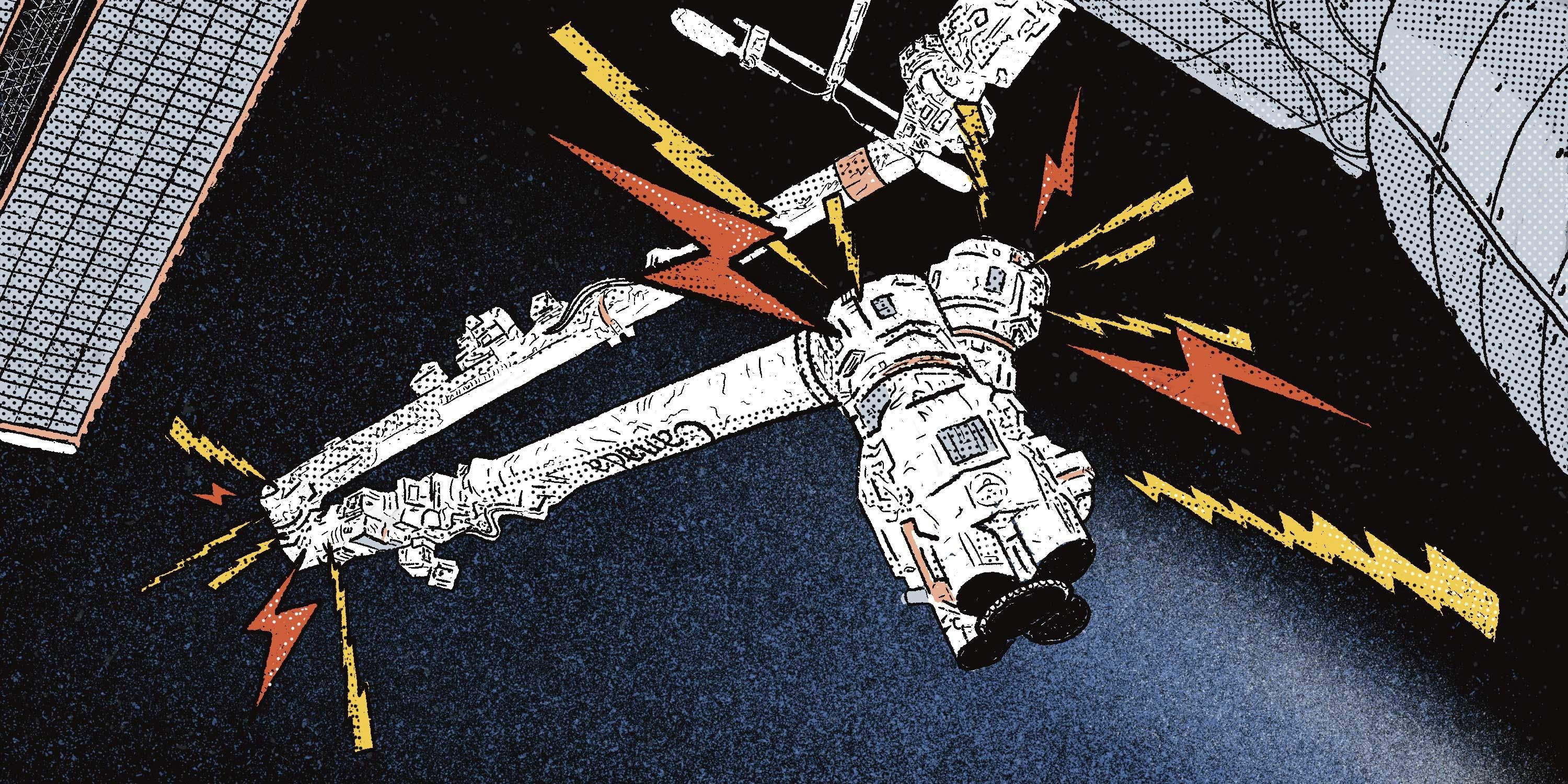
When your space robot gets broken, how do you fix it?
The International Space Station (ISS) has a spacecraft-catching, astronaut-hoisting arm called Canadarm2. Its functions are well known to readers of Supercluster and in Canada, whose honors for Canadarm2 include featuring the space robot on the $5 bill.
But perhaps less well known is that much of what Canadarm2 does today was not envisioned when it was installed on the ISS 25 years ago, in 2001, as space has changed significantly since the robot was designed, built, and tested between 1986 and 2001.
On June 30th, NASA astronauts Jessica Meir and Chris Williams — assisted by Canadian Space Agency (CSA) astronaut Jenni Gibbons in Mission Control, best known for being lunar flyby Capcom during Artemis 2 — ventured on a rare spacewalk outside the ISS to help Canadarm2. Something in one of its joints broke in May, requiring them to use one of the orbital spares handily stashed on board for a replacement.
“Canadarm2 was originally designed for 15 years of use, but as the space station exceeded expectations, so did the Canadarm,” Jason Dyer, CSA’s deputy liaison manager in Houston, said in a livestreamed press conference previewing the spacewalk in June. “It's aging gracefully, and it's showing signs of wear,” Dyer added. “However, this graceful aging was always part of the original design.”
NASA’s Bill Spetch, sitting in the same room at the agency’s Johnson Space Center, noted that Canadarm2 will have to work until the end of the space station program, which is expected to be in 2030. “The arm is critical to everything that we do on ISS,” he said, noting that the broken part will be shipped to the ground, refurbished, and returned on a future supply mission, just in case.
If Canadarm2 were to go down for an extended period of time, some cargo ships (like Northrop Grumman’s Cygnus) needing berthing would have to stand down for others that can dock, like SpaceX’s Dragon cargo variant. Moreover, Spetch noted, work the arm does for maintenance would have to be switched to astronauts, requiring more spacewalks and risk.
That’s why NASA is committed to keeping Canadarm2 going until the ISS is deorbited: “There's not a time,” Spetch said, “Where we go, say, ‘Hey, we're just done repairing the arm.’”
On June 30th, the spacewalking astronauts made their way from the Quest airlock to grab a spare for Joint 5 (the failed part) before arriving at Canadarm2 to do some surgery: temporarily removing one of the latching end effectors used to grasp on to spacecraft, uninstalling two working joints, and then diving into the mechanics of swapping the failed joint with the spare before piecing the arm back together again.
Near the end of the almost 7.5-hour-long spacewalk, Williams praised the robot’s performance in the NASA livestream: "Whether it is performing maintenance or replacing equipment, moving and operating payloads, catching cargo vehicles or helping us out during spacewalks, the arm has played — and will continue to play — an essential role in our work on orbit," Williams said.
Meir pointed to Canada’s July 1 national holiday, the very next day, as a welcome reward for the work. "We are thrilled to have repaired the mighty Canadarm2 just in time for Canada Day tomorrow. We hope that all in Canada and everyone around the globe can celebrate this achievement," she said.
So where did this arm come from, and how did it become a vehicle for repairing solar arrays, picking up astronauts during spacewalks, and helping to give the ISS the vital food, equipment, and other things upon which the crews depend to do their work?
Heritage
It’s hard to dig into the historical roots of the ISS without stumbling upon the archaeological remains of Space Station Freedom announced in 1984, which was a predecessor crewed space station concept intended to be built by the US with participation from some other countries. You can read a little of what happened to Freedom in a 2024 blog post at NASA; the simple version of that is the ISS was reconstituted from Freedom in part due to cost concerns, and in part to allow post-Cold War Russia to participate in 1993.
A robotic arm from Canada was supposed to play a role in both stations, but the ISS came with a key difference. Freedom was supposed to use other countries’ tech as “enhancements” to that station, while the Lego-like, module-by-module build of the ISS would depend upon using Canadarm2 to hoist modules into place during spacewalks. As such, “Canadarm2 would play a critical role in the station operations and assembly,” read an ISS case study uploaded to NASA’s website in 2015, led by the Air Force Center for Systems Engineering.
As the name implies, Canadarm2 succeeds Canadarm.
The predecessor arm has its own very deep history, with a lot of flown experience for the tech even before exceeding all expectations during the second space shuttle mission STS-2 in 1981. It’s featured in Hubble Space Telescope repairs, grappled many an astronaut or a satellite, assisted in belly-tile scans post-Columbia, and even was used to knock unexpected ice (carefully) off the space shuttle. IEEE once said the arm never malfunctioned in 30 years of service.
Canadarm’s tech dates at least to 1951, six years before Sputnik even kicked off orbital spaceflight, when engineer George Johann Klein of Canada’s National Research Council created what is now known as the storable tubular extendible mechanism or STEM. It was developed into an “antenna that can be retracted into a flat reel and rolled out again on command,” the Canadian Encyclopedia wrote. That design was perfect for space missions, to allow satellite antennas to fit into a rocket fairing for launch before deploying in orbit.
An organization in the Canadian government, then known as Canada’s Defence Research Telecommunications Establishment, asked the “Special Products” division of de Havilland Aircraft of Canada to supply a STEM antenna for Alouette, Canada’s first satellite that was ultimately launched in 1962. The tech proved so useful that many American satellites adopted it, the CSA has noted. In fact, all of the Mercury, Gemini, and Apollo spacecraft — the early missions of the US human space program — adopted the STEM for communications use.
Eventually, NASA, for various geopolitical and cost reasons beyond the scope of a short article, began to consider flying international astronauts when the space shuttle program was being developed. By then, which was the 1970s, Canada’s NRC was working with Toronto’s Spar Aerospace (essentially an outshoot of de Havilland) to create a robotic arm. NASA, most interested in that arm, extended an invitation for Canada to participate in the shuttle.
A pair of bilateral agreements in 1975 and 1976 (between Canada’s NRC and NASA) centered on Canada promising to supply a “remote manipulator system” — later known as Canadarm.
“As a result of Spar Aerospace's increasing capability, we could build the Canadarm for the brand new, nascent shuttle program,” recalled Canadian astronaut Chris Hadfield in a Supercluster interview this June. “NASA needed partners, and the Europeans built the Spacelab, and Canada built the Canadarm.”
After NASA saw how well the arm performed in space, Hadfield added, “that led to us then having astronauts.” Canada’s NRC was put in charge of that effort for a few years (as the CSA was later created in 1990). NRC recruited half a dozen Canadians for flights in 1983. Very quickly, in 1984, the first astronaut from Canada — Marc Garneau — flew on shuttle mission STS-41G as a payload specialist, responsible for several experiments and duties.
Canadarm tech, today managed by MDA Space, has helped CSA astronauts up into space ever since. “With the International Space Station, we provide the mobile robotic system — including Canadarm2 — and that then allowed us to have Canadian mission specialists,” Hadfield said, referring to a category of shuttle astronauts who took on more responsibilities on missions, such as spacewalks. “That's where the bulk of all Canadians have flown, was under that intergovernmental agreement.”
And now that the space shuttle has long retired, Canadians continue to fly to space under new intergovernmental agreements, fueled so far by robotics. As for the ISS, Canadarm2 flew early in its program to help build the station. The first pieces of ISS arrived in space in 1998. Canadarm arrived just three years later on “Assembly Flight 6A”, which was the ninth such mission for the ISS.
NASA put a lot of trust in the arm to work properly, as in 2021 the agency retroactively called installing the arm “the most complex series of robotic tasks of any shuttle mission.” And one of the two spacewalkers tasked to deploy it was Hadfield, on his first EVA alongside NASA’s experienced spacewalker Scott Parazynski.
There are a lot of fun stories around that installation, particularly during the final of the two spacewalks that April. The Canadian anthem was played in space. Steve MacLean, the CSA astronaut serving as capcom that day, wore a Canadian Olympic sweater on-camera.
Maple cookies were consumed, and Canadian flags were placed, all around Mission Control.
Then, to rudely interrupt the celebrations, several ISS computers weirdly failed… in a row. “Suspicion quickly spread that the newest addition to the ISS — Canadarm2 with all its complex software — was somehow causing the problem,” the CSA wrote in a 2021 blog post about the installation. “It was later found that simultaneous hardware and software failures in the ISS computers caused them all to fail within a short time. This exonerated Canadarm2.”
Hadfield, though retired, is still keeping an eye on Canadarm2. By coincidence, when Supercluster spoke with him on June 24th, he had just completed an Earth-to-space call with Meir that morning — roughly a week before the spacewalk. “She said she would do her best to take care of my arm,” Hadfield said. “So I was telling her, ‘Hey, that long ago, I built that thing out there. And so yeah, please treat it gently.’”
“Do you have any advice for her?” we asked.
Hadfield scoffed. “She doesn’t need my advice,” he said of Meir, who in 2019 and 2020 co-conducted the first three all-woman spacewalks with future Artemis 2 astronaut Christina Koch.
Our conversation moved to the engineering of Canadarm2, but while discussing its interfaces, Hadfield stopped a moment. “I do have something I want to tell Jessica,” he said. “I'll send her a note. It's just on expandable diameter fasteners, and making sure she has the benefit of my experience with those.”
Those expandable diameter fasteners (EDFs) are like hinges, and tightening the fasteners is used to make the arm’s two long booms (joints) more rigid. Parazynski and Hadfield had spent hours practicing the tightening in the big Neutral Buoyancy Laboratory pool at NASA’s Johnson Space Center before their spacewalks, but space always throws surprises. While they were outside, the automatic torque level on their pistol grip tool didn’t let them tighten the hinges at first. Switching to manual and adjusting the torque secured the arm safely, however.
Funny enough, 25 years later, one of the few issues during Meir’s and Williams’ successful spacewalk was one of those very same bolts, Hadfield later wrote on X. The brief struggle was broadcast via livestream during the spacewalk on June 30th.
"It's all the way in, but it is still free spinning," Meir said of the tricky bolt — designated as Bolt 1 — while speaking to Mission Control in her spacesuit. "It's a free spin, so it doesn't seem to be turning in conjunction with the rest of the EDF."
The astronauts are trained to describe what is happening in front of them, but not to linger on a task when Mission Control can also troubleshoot. While Williams (mindful of time) moved on to adjusting another bolt, Meir said she could see the top head of Bolt 1 free spinning, which to her suggested the hex head was engaged, even though the top washer was not moving left or right.
After some back and forth with Capcom and CSA astronaut Jenni Gibbons, who was hearing ideas from others in Mission Control, the spacewalking astronauts were told to apply force on the bolt's side to get Bolt 1 to properly thread.
A few moments later came the call: "I think that did it," Meir said.
"Yay," interjected Williams.
"I got 11 turns," Meir added.
"That's awesome! Great job, Jess," Gibbons said from the ground.
The Second
Soon after Canadarm2 arrived, the arm built a history of — to paraphrase Apollo 13, the movie — doing not what it was designed to do, but what it could do.
Parazynski himself experienced this in 2007 when Canadarm2 carried a boom, to which he secured himself, to reach far out on the space station towards a solar array that unexpectedly tore during deployment. The affected solar array panels — still fully powered, by the way — were carefully threaded back into place using improvised handmade tools the astronauts forged in days on the space station, under guidance from Mission Control.
By then, NASA was looking ahead to the retirement of the space shuttle and its cargo-carrying capabilities. Private spacecraft would need to take its place, and the agency determined Canadarm2 could be adapted to safely bring in or “berth” these spacecraft to the space station.
“Initially, Canadarm2 was not designed to perform cosmic catches,” the CSA stated in 2024. After all, how could it? SpaceX, as just one example of a company that has used berthing in past years, wasn’t even established when the ISS began its build in 1998. But by 2009, the arm’s procedures and software could be adapted, and Canadarm2 achieved its 50th such “cosmic catch” in 2024.
Support Supercluster
Your support makes the Astronaut Database and Launch Tracker possible, and keeps all Supercluster content free.
SupportAnother plot twist arose through years of careful experience. Canadarm2 was envisioned to be like its predecessor shuttle arm, with “astronauts driving at every step,” the CSA said in a blog post. But as the ISS matured and robotics team members gained confidence, more and more of the robotic operations pivoted to the ground. This helped open up scientific productivity on the station, since the astronauts could now focus more on experiments. Moreover, CSA showed so much capability in these ground operations that an independent control room at its HQ, near Montreal, was created. The CSA supports at least 100 days of robotic work a year with Canadarm2 at this facility today.
But one thing that has not changed over the decades is the approach to repairs of Canadarm2; if something can’t be resolved by remote control, NASA and its partners will switch to using a spare part stowed on station. In fact, it happened three times already before this year’s spacewalk. The first was during shuttle mission STS-111 in June 2002, when a broken wrist joint was also replaced. The second, a 2017 effort, saw two astronauts replace one of the “end effectors” used to latch on to and carry items on the station. The third, another two-astronaut repair in 2018, replaced the other end effector.
Yet another incident arose in 2021 that, luckily, did not require any spacewalking action at all. During a routine inspection, somebody noticed a new hole in the middle of the arm. Some piece of orbital debris, or maybe a small meteoroid, had hit smack in the center of Canadarm2 before that May.
“Despite the impact, results of the ongoing analysis indicate that the arm's performance remains unaffected,” CSA wrote in a blog post that month, after extensive analysis showing “the damage is limited to a small section of the arm boom and thermal blanket.” The arm was able to carry on despite the 5 mm-divot, turning next to help its Canadian robotic partner Dextre to get in position for an unrelated repair.
With NASA, CSA, and MDA Space all committed to keeping Canadarm2 going to at least 2030, that would prove such a robotic arm could continue for roughly three decades in space, pending periodic repairs. And there’s talk about the next generation: Canadarm3 is being designed and built by MDA Space, under a CSA contract.
Initially, Canadarm3 was going to be used on the NASA-led Gateway space station in exchange for Canadian seats and science on the Artemis program; that arrangement, for example, was how CSA’s Jeremy Hansen flew around the moon on Artemis 2 this April, with Gibbons serving as his backup. NASA’s more recent pivot to building Moon Base and pausing Gateway is being discussed among the consortium, but Canadarm3’s contract is continuing, and there are other companies interested in the tech aside from NASA, like Axiom Space, which purchased 32 external interfaces in 2022.
Hadfield, who was an astronaut for 21 years, said he wasn’t surprised at NASA’s recent shift to surface operations. “It's not going to be the way we originally thought it was eight years ago,” he said of Artemis. “Things evolve, and we just have to make sure that we stay current with it. And it's going to give us [Canadians] the opportunities that are just starting to become clear; there will be a Canadian walk on the moon in the relatively near future, which is pretty incredible.”
Hadfield, now 66, was inspired to strive for space in childhood by watching American moonwalkers between 1969 and 1972. Canada didn’t have an astronaut program back then, of course, but it ended up happening in time for Hadfield to reach space on three occasions, visiting both the ISS and Mir. And now, Hadfield said, the newer Canadian astronauts have opportunities that were impossible for him.
“That is the direct, measurable impact of almost, well, 65 years of good Canadian policy and trustworthy Canadian partnership” with the Americans, Hadfield said.
Looking ahead, he promised, “We are going to continue to be that entity in the world space business. But we need to all evolve as well.”